

The officer paused the video at the exact moment David’s hand closed around my wrist.
On the screen, his face looked almost calm.
That was the part that disturbed me most.
He wasn’t shouting.
He wasn’t out of control.
He wasn’t having some kind of emotional breakdown.
He looked completely aware of what he was doing.
My own voice came from the phone speaker.
“You’re hurting me.”
David leaned closer to me on the recording.
“Then stop making everything difficult.”
The officer let the video play another few seconds.
David shoved me backward.
My shoulder hit the wall.
The camera shook.
Then the recording ended.
Nobody in the kitchen spoke.
The little black makeup bag still sat on the counter beneath the bright morning light.
Beside it were the photocopy of my missing passport, the forged property document, the mysterious bank statement, the sticky note with the percentages, and the hotel key card.
Everything that had seemed impossible less than an hour earlier was now arranged in neat rows like pieces of a puzzle.
The first officer looked at me.
“Mrs. Vance, do you want to make a formal report?”
For six years, I had imagined that moment in dozens of different ways.
I had imagined screaming.
Crying.
Running barefoot into the street.
Calling my sister at midnight.
Leaving while David slept.
Packing one suitcase and disappearing.
But whenever I imagined actually telling someone what was happening, another voice always appeared inside my head.
David’s voice.
Nobody will believe you.
You’re too emotional.
You’ll embarrass yourself.
My mother knows everyone in this town.
Do you really think anyone is going to take your side?
I looked at Rachel.
She didn’t nod.
She didn’t tell me what to do.
She simply stood beside me.
For once, nobody was deciding for me.
I looked back at the officer.
“Yes.”
My voice shook.
So I said it again.
“Yes. I want to make a report.”
Something inside me shifted.
Not healed.
Not disappeared.
Shifted.
The officer nodded.
“All right.”
He started asking questions.
How long had the abuse been happening?
Had David ever threatened to kill me?
Did he have access to firearms?
Had he ever prevented me from leaving the house?
Taken my money?
Confiscated identification?
Tracked my phone?
Threatened family members?
Some questions were easy.
Others made me realize things I had spent years refusing to name.
Yes, David had taken my car keys during arguments.
Yes, he knew all my passwords.
Yes, he checked the mileage on my car.
Yes, he had convinced me to stop working after my father died.
Yes, he had gradually taken control of every household account.
Yes, he had hidden my passport.
I had assumed I lost it.
Now it was sitting on the kitchen island.
Or rather, a photocopy of it was.
One officer photographed my bruises.
Purple marks crossed my upper arm.
Another bruise darkened the side of my ribs where David had pushed me against the edge of the bathroom vanity three nights earlier.
I had planned to cover both with makeup.
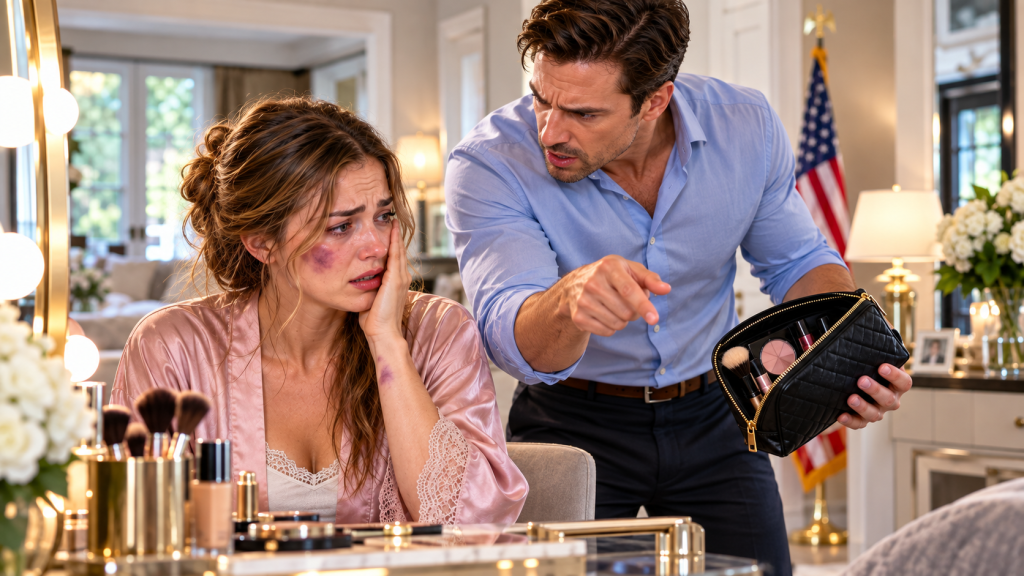
That was why he brought me the bag.
Freshen up and smile.
His exact words.
His mother was coming.
He didn’t want Eleanor to see what he had done.
That was what I had believed.
Now I wasn’t sure anymore.
Maybe Eleanor already knew.
Maybe the makeup bag had never been about hiding anything from her.
Rachel’s phone rang.
She glanced at the screen.
“I need to take this.”
She walked toward the dining room.
I continued answering questions.
At 9:38, Rachel returned.
Her face had changed.
Not panic.
Not exactly.
Something sharper.
“Sarah.”
I looked up.
“What?”
She held her phone tightly.
“North Shore Residential Holdings was formed three months ago.”
My stomach tightened.
“And?”
“The registered business address belongs to a mail service downtown.”
“That doesn’t tell us anything.”
“No.”
She hesitated.
“But one of the listed managers is Michael Trent.”
For a second, the name meant nothing.
Then it hit me.
“Michael?”
Rachel nodded.
Michael Trent had been David’s accountant for years.
Before that, he had worked with my father.
When Dad died, Michael helped settle parts of the estate.
He reviewed tax documents.
He knew exactly what I inherited.
He knew about the house.
He knew about the investment account Dad left me.
He had even sat across from me at this same kitchen island and told me I should feel lucky that my father had planned carefully.
I felt suddenly sick.
“He knows everything.”
“I know.”
“He knows what the house is worth.”
“Yes.”
“He knows about the trust.”
Rachel looked at me.
“Yes.”
Before I could say anything else, the doorbell rang.
Every person in the kitchen froze.
The sound seemed impossibly loud.
One officer checked the time.
9:41.
David had told me he would return at noon.
The doorbell rang again.
Then someone knocked.
Three hard knocks.
A woman’s voice came from outside.
“Sarah?”
Eleanor.
My entire body went cold.
Rachel stepped beside me.
The officer motioned for everyone to stay where they were and moved toward the hallway.
Then Eleanor shouted again.
“Sarah, open the door.”
Another voice followed.
A man.
“Sarah, we need to talk.”
Michael.
Rachel stared at me.
I whispered, “That’s him.”
The officer moved to the front window and looked through the curtain.
“Two people.”
Then Michael called through the door.
“Please don’t make this worse.”
A second officer reached for his radio.
Eleanor’s voice sharpened.
“We know you found the bag.”
That sentence changed everything.
Until then, some part of me had still hoped there was an explanation.
A strange one.
A complicated one.
Something involving paperwork I didn’t understand.
But Eleanor knew.
Michael knew.
They knew I had the bag.
And they were here less than ninety minutes after David left.
The officer opened the door only after positioning himself between me and the entryway.
Eleanor stood on the porch wearing a cream-colored coat and sunglasses.
Michael stood beside her in a gray suit.
The moment they saw the police uniforms, both stopped.
Eleanor recovered first.
“What is this?”
The officer answered calmly.
“Ma’am, who are you?”
“I’m the homeowner’s mother-in-law.”
“You’ll need to remain outside.”
Eleanor looked past him and found me.
Her expression changed.
Not concern.
Not surprise.
Anger.
“Sarah.”
I didn’t answer.
Michael started backing away.
The second officer stepped outside.
“Sir, please stay where you are.”
Michael stopped.
“I haven’t done anything.”
The officer looked at him.
“Nobody said you did.”
Michael said nothing.
Eleanor removed her sunglasses.
“Sarah, this has gone far enough.”
Rachel moved closer to the doorway.
“Mrs. Vance is represented by counsel.”
Eleanor looked at her.
“And you are?”
“Rachel Kim.”
Recognition flashed across Eleanor’s face.
That startled me.
Rachel saw it too.
“You know who I am?”
“No.”
“You reacted like you did.”
Eleanor ignored her.
“This is a family matter.”
The officer answered.
“It stopped being only a family matter when a report was made.”
Eleanor’s eyes snapped back to me.
“You called the police?”
I almost laughed.
The question was so absurd.
Not Are you hurt?
Not What happened?
Not Why are there forged papers in my son’s makeup bag?
You called the police?
“Yes.”
Eleanor’s jaw tightened.
“You don’t understand what you’re doing.”
“I’m starting to.”
“You could destroy David’s career.”
For years, those words would have worked.
David’s reputation.
David’s career.
David’s clients.
David’s future.
Everything had always been more important than my safety.
I looked at the bruise around my wrist.
“He should have thought about that.”
Eleanor stared at me.
Then her expression softened with terrifying speed.
“Sweetheart.”
I had heard that voice before.
Usually right before she asked me for something.
“You’re upset.”
Rachel interrupted.
“Do not attempt to pressure her.”
“I’m speaking to my daughter-in-law.”
“No. You’re speaking to someone who just discovered documents bearing what appears to be her forged signature.”
Michael’s face went pale.
Eleanor turned toward him.
Just for half a second.
But it was enough.
Rachel noticed.
The officers noticed.
I noticed.
Michael immediately said, “I don’t know what she’s talking about.”
Rachel looked almost bored.
“That’s interesting because nobody said which documents.”
Michael’s mouth opened.
Closed.
The first officer stepped onto the porch.
“Sir, I’m going to need your full name.”
Michael gave it reluctantly.
The officer wrote it down.
Eleanor tried again.
“Sarah, let us come inside. We can explain everything.”
“No.”
“Please.”
“No.”
“You’re making a terrible mistake.”
I looked directly at her.
“Then explain the envelope.”
Silence.
Eleanor glanced toward the officer.
“What envelope?”
“The one with my passport copy.”
Nothing.
“The deed.”
Still nothing.
“The forged authorization.”
Michael looked down.
“And the note about forty percent for David, forty percent for you, and twenty percent for Michael.”
Eleanor’s face lost all color.
That was the moment I knew.
Not suspected.
Knew.
She hadn’t expected me to find that note.
Michael spoke too quickly.
“That doesn’t mean anything.”
Rachel answered.
“It means enough to investigate.”
Eleanor took a slow breath.
Then she looked at me with something close to hatred.
“You were supposed to sign the final paperwork this afternoon.”
The porch went silent.
Even Michael turned toward her.
“Eleanor.”
But she kept going.
“You would have been compensated.”
I stared at her.
“For my own house?”
“You don’t need a house this size.”
I actually laughed then.
A short, stunned sound.
She frowned.
“David has debts.”
“There it is.”
“This family has obligations you know nothing about.”
“And your solution was to steal my house?”
“We were restructuring assets.”
Rachel said, “Stop talking.”
But Eleanor couldn’t.
That was always her weakness.
She believed she was the smartest person in any room.
And smart people, in Eleanor’s mind, didn’t need to be careful.
“David has spent years supporting Sarah.”
I stared at her.
“With my money.”
She looked away.
“My father bought this house.”
“You’re married. Assets become complicated.”
“Not this one.”
Rachel spoke quietly.
“She’s correct. The property was purchased before marriage through funds traceable to an inheritance and remained titled solely in Sarah’s name.”
Michael rubbed his forehead.
Eleanor snapped, “You have no idea what arrangements were made.”
Rachel looked at her.
“Then perhaps you should explain them to investigators.”
That finally silenced her.
The officers separated Michael and Eleanor and began speaking to them individually.
I stepped away from the front hall.
My knees felt weak.
Rachel followed me into the kitchen.
“Sit.”
This time I did.
“What did she mean about signing paperwork this afternoon?”
Rachel looked toward the front door.
“I don’t know yet.”
“She said I was supposed to sign something.”
“Yes.”
“But I wasn’t going anywhere.”
Rachel slowly looked at the makeup bag.
Then the hotel key card.
Something clicked.
She picked it up.
“Sarah, what hotel is this?”
I read the tiny silver letters.
“The Harbor Crest.”
“Do you know it?”
“Yes. Downtown.”
“Did David mention going there?”
“No.”
“Was Eleanor supposed to come here?”
“Yes.”
“What exactly did David say before he left?”
I closed my eyes and replayed the morning.
He had stood beside the kitchen counter in a navy suit.
Perfect tie.
Perfect hair.
As if the bruise on my face had nothing to do with him.
“My mother will be here around ten,” he said.
I had asked why.
He told me not to start.
Then he set the black makeup bag beside my coffee.
“Freshen up and smile.”
I remembered something else.
“He said I needed to look presentable because we were going out.”
Rachel leaned forward.
“Where?”
“He didn’t say.”
“What else?”
I searched my memory.
“He told me to wear the gray dress.”
“Why?”
“I don’t know.”
“Anything about medication? Food? Drinks?”
My stomach turned.
“He told me not to eat breakfast.”
Rachel’s expression sharpened.
“Why?”
“He said Eleanor had brunch reservations.”
She looked toward the hotel card again.
“Sarah, I think they planned to take you somewhere.”
My skin prickled.
“To the hotel?”
“Possibly.”
“For what?”
Rachel didn’t answer.
She picked up the bank statement.
“Let’s look at this again.”
The account belonged to North Shore Residential Holdings.
The balance was enormous.
More than eight hundred thousand dollars.
I stared.
“Where did that money come from?”
Rachel scanned the transactions.
“Multiple deposits.”
She stopped.
“Some from private lenders.”
“Meaning?”
“Possibly bridge financing.”
“For buying my house?”
“Or using it as collateral.”
I felt dizzy.
The room tilted.
Rachel immediately put down the page.
“Look at me.”
I did.
“You’re safe right now.”
I nodded.
But my mind had gone somewhere else.
Two weeks earlier, David had asked me a strange question.
If anything ever happened to me, did I still want the house to go to my sister?
I thought he was talking about estate planning.
I had laughed and asked why he was suddenly thinking about death.
He told me one of his clients had passed away unexpectedly.
At the time, I believed him.
Now the memory made my stomach twist.
“Rachel.”
“What?”
“I need to tell you something.”
I explained the conversation.
Her entire expression changed.
“Did you update your will?”
“No.”
“Does David know that?”
“Yes.”
“Does he benefit from your estate?”
“Some accounts, yes. But the house goes to my sister.”
Rachel stood.
“I need to tell the officers.”
“What does that mean?”
“It means nothing by itself.”
“But?”
“But combined with forged transfer papers, concealed identification, possible financial fraud, and documented abuse, I want it recorded.”
She went to the hallway.
I sat alone again.
The coffee beside me had gone cold.
I looked around my kitchen.
Six years earlier, after we married, David and I had spent an entire weekend choosing cabinet handles.
He wanted brushed nickel.
I wanted brass.
We laughed for hours because neither of us could make a decision.
That version of my marriage felt like something I had watched happen to another woman.
There had been good years.
That was what made everything so confusing.
David hadn’t hurt me on our first date.
He hadn’t insulted me on our wedding day.
He hadn’t controlled my bank account immediately.
It happened slowly.
A criticism here.
A joke there.
A password he wanted “for emergencies.”
A friend he thought was a bad influence.
A job he said was exhausting me.
A bank account he could manage more efficiently.
Then one day I realized he knew every place I went, every dollar I spent, every person I spoke to.
By then, leaving felt more impossible than staying.
The first time he hit me, he cried afterward.
Actually cried.
He sat on the bathroom floor with his face in his hands and said he hated himself.
I believed him.
The second time, he blamed stress.
The third time, he blamed me.
After that, apologies became shorter.
Eventually, they disappeared entirely.
At 10:17, the officers asked whether I wanted to leave the house temporarily.
Rachel immediately said yes.
I hesitated.
“This is my home.”
“I know,” she said.
“Why should I leave?”
“You shouldn’t have to.”
“Then why are we?”
“Because David has access. We can change locks later, but right now I’d rather put distance between you and whatever happens next.”
I looked toward the living room.
“My father gave me this house.”
“I know.”
“I feel like they’re taking it again.”
Rachel sat beside me.
“They are not taking it.”
That sentence mattered.
Not because I fully believed it.
But because someone finally said it.
I packed a small overnight bag.
Clothes.
Medication.
My laptop.
The original deed from the fireproof box.
My birth certificate.
My father’s estate paperwork.
The officers stayed while I packed.
When I opened the fireproof box, I discovered something else missing.
My father’s trust document.
I stared at the empty space.
“No.”
Rachel came over.
“What?”
“It’s gone.”
“What?”
“The trust.”
She looked inside.
“Are you sure?”
“Yes. I keep everything in folders. Deed, insurance, trust.”
We searched the box twice.
Nothing.
Rachel told the officer.
He wrote it down.
At 10:42, Michael and Eleanor were allowed to leave after providing statements and contact information.
Before Eleanor walked away, she looked at me through the open door.
“You will regret humiliating this family.”
The officer immediately stepped between us.
Rachel answered before I could.
“She has nothing further to say to you.”
Eleanor smiled.
Not warmly.
“You think you’re helping her?”
Rachel didn’t respond.
“You have no idea who David is connected to.”
That sentence stayed with me.
The officer ordered Eleanor to leave.
She did.
Michael followed.
Neither looked back.
At 11:06, Rachel drove me to her apartment.
We didn’t go to a hotel.
She didn’t trust the key card.
We didn’t know whether David could track my credit card, bank account, or phone.
So we turned off my phone and placed it in a metal storage tin in Rachel’s spare room.
Then she called the phone company from her own device and started helping me secure accounts.
At 11:48, my phone began vibrating inside the tin.
Once.
Twice.
Again.
Again.
By noon, there were seventeen missed calls.
David.
At 12:11, he left the first voicemail.
Rachel asked if I wanted to hear it.
I said yes.
His voice was controlled.
“Sarah, call me. My mother said there was some kind of misunderstanding at the house. Whatever she told you, don’t overreact.”
I almost smiled.
Misunderstanding.
At 12:19, another voicemail.
“Sarah, this is serious. You need to call me before you create problems that cannot be fixed.”
At 12:27:
“I know you’re with Rachel.”
That frightened me.
Rachel saw my face.
“He may know because his mother saw me.”
I nodded.
Then another message.
“You have documents that don’t belong to you.”
Rachel raised an eyebrow.
I whispered, “They had my name on them.”
At 12:44, his tone changed completely.
“Baby, please call me.”
I hated that one most.
“Whatever you think happened, I can explain. Mom got involved in something she didn’t understand. Michael made a mistake. I was trying to protect us.”
Us.
There had never been an us when David wanted something.
At 1:03, the final voicemail arrived.
“You are making the worst mistake of your life.”
Rachel saved copies of everything.
At 1:30, a detective called.
Not the patrol officers.
A financial crimes investigator.
Detective Alvarez.
He asked whether I could meet that afternoon.
We went to the station.
For almost three hours, I told the story from the beginning.
My inheritance.
The house.
David’s increasing control.
The missing passport.
The abuse.
The forged paperwork.
Michael.
Eleanor.
The hotel card.
The bank account.
The note.
When I finished, Alvarez leaned back.
“I want to be careful about what I say.”
I nodded.
“This appears bigger than a domestic violence case.”
My hands tightened around each other.
“How much bigger?”
“We’re trying to determine that.”
He slid the hotel key card across the table.
“We contacted the Harbor Crest.”
My mouth went dry.
“And?”
“The card corresponds to a conference suite rented today from eleven in the morning until three.”
“Who rented it?”
“North Shore Residential Holdings.”
Rachel and I looked at each other.
Alvarez continued.
“The hotel also confirmed catering for five people.”
“Five?”
“Yes.”
“Who?”
“They don’t have all the names. But the booking notes mention a mobile notary service.”
I stared at him.
“A notary?”
“Yes.”
Rachel leaned forward.
“For property documents?”
“Possibly.”
I suddenly remembered David telling me to wear the gray dress.
My nice dress.
The one he called respectable.
I had assumed brunch.
Maybe he wanted me to look composed.
Presentable.
Like a woman voluntarily attending a business meeting.
“What would have happened if I went?”
Alvarez didn’t speculate.
“We don’t know.”
Rachel asked, “Was there anything else booked?”
“Yes.”
The detective paused.
“A car service.”
I felt cold again.
“From where?”
He looked at me.
“Your house.”
I couldn’t speak.
“To where?”
“The hotel.”
“And after?”
“The reservation listed a second destination.”
Rachel asked the question because I couldn’t.
“Where?”
Alvarez slid a piece of paper across the table.
The destination was a private wellness facility almost ninety miles away.
I stared at the name.
“I’ve never heard of this place.”
Alvarez said, “It specializes in residential treatment.”
“For what?”
“Mental health and substance issues.”
I nearly laughed.
“I don’t have a substance issue.”
Rachel looked at the detective.
“Was Sarah registered?”
“We called.”
The detective’s expression hardened.
“A preliminary intake had been opened under her name.”
The room went silent.
I felt something inside me collapse.
“What?”
“They received paperwork yesterday.”
“What kind of paperwork?”
“Claims that you had become increasingly unstable.”
I stopped breathing.
“Unstable?”
“Paranoid episodes. Alcohol misuse. Self-harm concerns. Financial impulsivity.”
“That’s not true.”
“I know what you’re telling me.”
“Who sent it?”
“The referral appears to have been submitted by your husband.”
I stood so quickly the chair scraped backward.
“No.”
Rachel stood too.
“Sarah.”
“No.”
I started pacing.
“He was going to make me disappear.”
Nobody corrected me.
That frightened me more.
“He was going to take me to a hotel, make me sign my house away, and then send me to some facility?”
Alvarez answered carefully.
“We are investigating what the plan was.”
“But that’s what it looks like.”
“It is one possibility.”
I pressed both hands to my face.
Suddenly every strange moment from the past month returned.
David telling friends I was forgetful.
Eleanor joking that I had become “a little emotional.”
Michael asking whether I had considered letting David handle all legal decisions “for convenience.”
My missing passport.
My missing trust document.
The questions about my will.
The bruise.
The makeup bag.
Freshen up and smile.
Maybe the makeup wasn’t only for Eleanor.
Maybe it was for the notary.
Maybe they needed me to arrive looking calm.
Uninjured.
Cooperative.
A woman voluntarily signing documents.
Rachel touched my shoulder.
“You don’t have to keep talking right now.”
I lowered my hands.
“Yes, I do.”
I sat down again.
“Tell me everything.”
Detective Alvarez nodded.
“The treatment center had not completed admission approval. They requested a physician evaluation first.”
“So I couldn’t just be taken there?”
“Not legally without consent unless certain emergency criteria were met.”
Rachel said, “Which could explain the claims of self-harm.”
Alvarez nodded.
“Possibly.”
I felt nauseated.
“Did David tell them I was suicidal?”
The detective looked at his notes.
“The intake summary says your husband expressed concern you were a danger to yourself.”
I laughed then.
I couldn’t help it.
Not because it was funny.
Because it was monstrous.
David had spent six years hurting me.
Then he planned to tell strangers I was the danger.
That evening, Rachel and I stayed at her apartment.
At 8:16, Detective Alvarez called again.
They had located David.
He had gone to his office.
Police spoke with him there.
He denied assaulting me.
Denied forging anything.
Denied planning to transfer the property without consent.
Claimed the hotel meeting was supposed to be a “family financial intervention.”
Claimed the treatment center referral was motivated by genuine concern for my mental health.
Rachel shook her head.
“Classic.”
I looked at her.
“What?”
“Create a narrative before anyone can challenge it.”
“He’ll make people believe him.”
“He might make some people believe him.”
“That’s what he does.”
Rachel leaned toward me.
“But this time there are documents.”
That became my anchor.
Documents.
Video.
Voicemails.
Bank records.
Hotel bookings.
Treatment paperwork.
A forged signature.
For years, David had controlled the story.
Now the story had paper attached to it.
The next morning, Detective Alvarez called us back.
He had news about the mysterious twenty percent.
Michael.
The bank records linked him directly to North Shore Residential Holdings.
Not merely as an accountant.
As an investor.
He had contributed money to the company.
So had Eleanor.
David had contributed almost nothing.
Instead, records indicated David planned to contribute an “acquired residential asset.”
My house.
The plan, according to draft emails recovered through warrants days later, was shockingly simple.
Transfer my house to North Shore Residential Holdings at a price far below market value.
Use the property as collateral to secure a larger loan.
Pay off David’s private debts.
Then renovate and either sell or refinance the house.
The projected profit was divided:
Forty percent David.
Forty percent Eleanor.
Twenty percent Michael.
My home had been reduced to percentages on a sticky note.
But there was another problem.
They needed my signature.
The forged preliminary authorization wouldn’t be enough to complete everything.
They needed documents witnessed and notarized.
That was why the hotel suite existed.
The plan had been to pressure me into signing.
Detectives later recovered emails discussing what they called “the Sarah issue.”
One email from Michael read:
She may resist if presented with the full details.
Eleanor replied:
Then don’t present the full details.
David wrote:
I’ll handle her.
Another email mentioned the treatment center.
Eleanor:
If she causes a scene, we proceed with the alternate plan.
Michael:
Only if legal exposure is contained.
David:
Leave that to me.
When Detective Alvarez showed me those emails, I felt no satisfaction.
Only emptiness.
They had discussed me like a logistical problem.
A shipment.
A stubborn account.
Not a person.
The most disturbing discovery came from David’s laptop.
A folder labeled SV MEDICAL.
Inside were notes documenting fabricated incidents.
Dates when I had supposedly threatened self-harm.
Dates when I had supposedly blacked out from drinking.
Dates when I had supposedly become paranoid.
Some dates were easy to disprove.
One claimed I had been intoxicated and violent at home during a weekend when I was visiting my sister in another state.
Another claimed I had threatened to jump from our bedroom balcony.
We didn’t have a balcony.
But the purpose wasn’t truth.
It was volume.
Enough allegations repeated enough times could create a cloud.
And if David told people I was unstable before I accused him of abuse, he could claim my allegations were simply part of the instability.
That realization hurt almost more than the bruises.
He had planned for my escape.
Not to stop it.
To discredit it.
Three days later, a judge granted me a temporary protective order.
David was prohibited from contacting me directly.
He had to stay away from the house.
The locks were changed.
Security cameras were installed.
For the first time in six years, I walked through my own front door without wondering what mood my husband might be in.
The silence felt strange.
I stood in the hallway for a long time.
Then I noticed the dent in the wall.
The place where my shoulder had struck it.
I had been meaning to repair it.
David told me we would.
We never did.
I ran my fingers over it.
Then I called a contractor.
“Don’t patch it,” I told him.
He sounded confused.
“You don’t want it repaired?”
“I want the whole section replaced.”
I didn’t want to hide damage anymore.
A week later, Eleanor tried to contact me through a family friend.
The message was almost unbelievable.
She wanted to “resolve everything privately.”
According to the friend, Eleanor was concerned about “unnecessary damage to multiple families.”
Rachel told the friend all communication had to go through attorneys.
Two days later, Eleanor’s lawyer sent a proposed settlement.
She would withdraw any interest in North Shore Residential Holdings.
She would provide a written apology.
She would never contact me again.
In exchange, I would decline to “pursue additional civil remedies.”
Rachel read it twice.
Then looked at me.
“What do you want to do?”
That question had become important.
What do you want?
Not what keeps David calm.
Not what protects Eleanor.
Not what avoids embarrassment.
What do you want?
“I want the truth documented.”
Rachel nodded.
“Then we reject it.”
We did.
Michael was the first one to break.
Facing potential fraud charges and terrified of losing his professional license, he cooperated.
He turned over emails.
Financial records.
Draft contracts.
Messages.
And one recorded conversation.
Michael had apparently begun recording meetings after he realized David and Eleanor might blame everything on him if the scheme failed.
In the recording, Eleanor said:
“Once Sarah signs, David controls the situation.”
Michael replied:
“And if she refuses?”
David answered.
“She won’t.”
Eleanor asked:
“You’re certain?”
David laughed.
“I know my wife.”
Then Michael asked about the treatment center.
David said:
“If she becomes hysterical, we take her there. By the time she convinces anyone she’s fine, the transfer is already moving.”
I listened to the recording once.
Only once.
Then I told Rachel I never wanted to hear it again.
Months passed.
The criminal case moved slowly.
Much more slowly than television makes these things seem.
There were interviews.
Hearings.
Paperwork.
Delays.
Arguments over evidence.
Experts examining signatures.
Financial analysts tracing accounts.
Lawyers filing motions.
Meanwhile, I had to learn how to live.
That was harder than I expected.
For the first month, I still woke up whenever floorboards creaked.
I checked the locks three times before bed.
I jumped whenever a car slowed in front of the house.
I apologized constantly.
To Rachel.
To my sister.
To cashiers.
To delivery drivers.
Sorry became another version of fine.
A habit built from surviving someone else’s moods.
I started therapy.
The first session, I barely spoke.
The therapist asked what I wanted from counseling.
I said, “I want to stop feeling stupid.”
She didn’t tell me I was stupid.
She didn’t tell me I was strong.
She asked why I believed recognizing manipulation late meant I was foolish.
I didn’t have an answer.
Slowly, I learned the difference between trusting someone and deserving what they did with that trust.
I returned to work.
Not because I needed the salary.
Because I needed something that belonged only to me.
A former colleague helped me find a position with a small nonprofit that managed community grants.
The first morning, I sat in my car outside the office for fifteen minutes.
Then I walked inside.
Nobody asked where I had been for six years.
Nobody checked my phone.
Nobody demanded my passwords.
Nobody told me what to wear.
The freedom was so ordinary it made me cry in the restroom.
Nine months after the makeup bag appeared on my kitchen counter, David accepted a plea agreement.
He admitted to assault connected to the recorded incident and to participating in the attempted fraudulent transfer of my property.
Additional financial charges were included in the agreement.
I did not attend every court appearance.
But I attended sentencing.
Not for him.
For me.
David wore a dark suit.
The same kind he had always worn when he wanted the world to see a respectable man.
He looked smaller.
Not physically.
Just ordinary.
That surprised me.
For years, he had seemed enormous in my life.
His anger controlled rooms.
His silence controlled meals.
His approval controlled how I saw myself.
Now he was simply a man standing beside his lawyer.
When the judge asked whether I wanted to give a statement, I stood.
My hands trembled.
I had written three pages.
I used only one.
“I spent years believing the most dangerous thing I could do was make my husband angry. I was wrong. The most dangerous thing I did was believe I had to disappear so he could remain comfortable. He did not only hurt me physically. He tried to take my home, my reputation, my financial independence, and eventually my credibility. He created a version of me on paper that did not exist so that if I ever told the truth, people might doubt me.”
David stared forward.
I continued.
“The morning this ended, he told me to hide my bruises before his mother arrived. He gave me a makeup bag. Inside that bag was the evidence of what they were planning. He thought he was handing me something to cover the truth. Instead, he handed me the truth itself.”
The courtroom was silent.
“I am not asking the court for revenge. I am asking the court to understand that what happened was not one bad argument. It was a pattern. It was planning. It was control. And I will spend the rest of my life making sure that pattern no longer defines me.”
I sat down.
I never looked at David again.
Eleanor faced separate proceedings related to the financial scheme.
Michael cooperated and received a reduced sentence and professional sanctions.
North Shore Residential Holdings was dissolved.
The loans were canceled.
My house remained mine.
Months after everything ended, Rachel came over for dinner.
We sat at the kitchen island.
The same place where she had photographed the envelope.
The same place where I had discovered my father’s missing documents.
The same place where my entire life had cracked open.
“You changed the cabinets,” she said.
“I did.”
“And the counters.”
“Yep.”
She smiled.
“You hated those counters.”
“I did.”
“David liked them.”
“I know.”
That was exactly why I replaced them.
Not because I wanted to erase every trace of him.
I eventually realized that would be impossible.
David had been part of my life.
Pretending otherwise would only give him another kind of power.
Instead, I changed the things I wanted to change.
I kept the dining table because I liked it.
I donated his leather chair because I hated it.
I repainted the bedroom.
I replaced the dented section of hallway wall.
And eventually, I packed the black makeup bag into an evidence return box.
When the case ended, authorities offered to return the items they no longer needed.
The bag came back.
For days, I didn’t touch it.
Then one Saturday morning, I placed it on the kitchen counter.
Sunlight fell across the zipper.
It looked harmless.
Cheap.
Ordinary.
I opened it.
Inside were the makeup brushes.
Foundation.
Powder.
Concealer.
Everything David expected me to use that morning.
The envelope was gone, preserved with case evidence.
The hotel card had been retained too.
But the makeup remained.
I picked up the concealer.
Shade 3.
Almost exactly my skin tone.
Of course David knew which one.
I stared at it for a long time.
Then I walked to the trash.
I dropped everything inside.
The brushes.
The foundation.
The powder.
The little mirror.
Finally, the bag itself.
I closed the lid.
That should have felt dramatic.
It didn’t.
It felt ordinary.
And maybe that was better.
Healing had not been one grand moment.
It was hundreds of ordinary ones.
Sleeping through the night.
Buying groceries without explaining the receipt.
Leaving my phone face down without fear.
Going out with friends.
Laughing too loudly.
Turning off the porch light.
Making decisions without rehearsing how someone else might react.
One afternoon, nearly eighteen months after David handed me the makeup bag, I received a letter.
Not from David.
From a woman named Melissa.
I almost didn’t open it.
Inside, she explained that she had dated David briefly years before he met me.
She had seen news about the case.
She wrote that he had never hit her, but he had controlled her money, isolated her from friends, and convinced her that she was unstable whenever she challenged him.
For years, she had wondered whether she had imagined it.
She ended with one sentence.
Seeing you speak made me trust my own memory again.
I sat at the kitchen table and cried.
Not because I felt responsible for her.
I wasn’t.
Not because I had saved her.
I hadn’t.
I cried because I finally understood something.
Silence doesn’t only trap one person.
Sometimes it leaves footprints for the next.
I wrote Melissa back.
I kept it simple.
I believe you.
Months later, I sold the house.
People were surprised.
Especially Rachel.
“I thought this place meant everything to you.”
“It did.”
“Then why sell?”
I looked around the kitchen.
“It belonged to my father.”
She nodded.
“And then it became the place where David controlled me.”
“Yes.”
“And then it became the place where I got free.”
Rachel smiled.
“So why leave?”
“Because I don’t need a building to prove any of that happened.”
That spring, I bought a smaller house near the lake.
Nothing fancy.
Two bedrooms.
A little garden.
A porch barely large enough for two chairs.
The first night, I sat outside with a glass of lemonade while the sun disappeared behind the trees.
My sister called.
“How does it feel?”
I looked through the open door.
Boxes everywhere.
Bare walls.
No curtains.
No history.
“Quiet.”
“Good quiet?”
I thought about it.
“Yes.”
Very good quiet.
Before bed, I opened the bathroom drawer.
Inside was a new makeup bag.
Bright blue.
I had bought it myself.
There was lipstick inside.
Mascara.
Powder.
Nothing meant to hide bruises.
Nothing chosen by David.
Nothing connected to fear.
Just makeup.
The next morning, I got ready for work.
I stood in front of the mirror.
For a moment, I remembered that other morning.
David dropping the black bag beside my coffee.
Freshen up and smile.
I remembered the envelope.
The forged signature.
The percentages.
The hotel suite.
The treatment center.
The police.
The courtroom.
The years it took to understand what had happened to me.
Then I looked at my own reflection.
No bruise.
No concealer.
No husband standing behind me telling me how I should look.
I smiled.
Not because anyone ordered me to.
Because I wanted to.
And for the first time in a very long time, that difference felt like everything.
💬THE END! THANK YOU FOR READING!