

“Why didn’t you tell me?”
Evan stared at his hands.
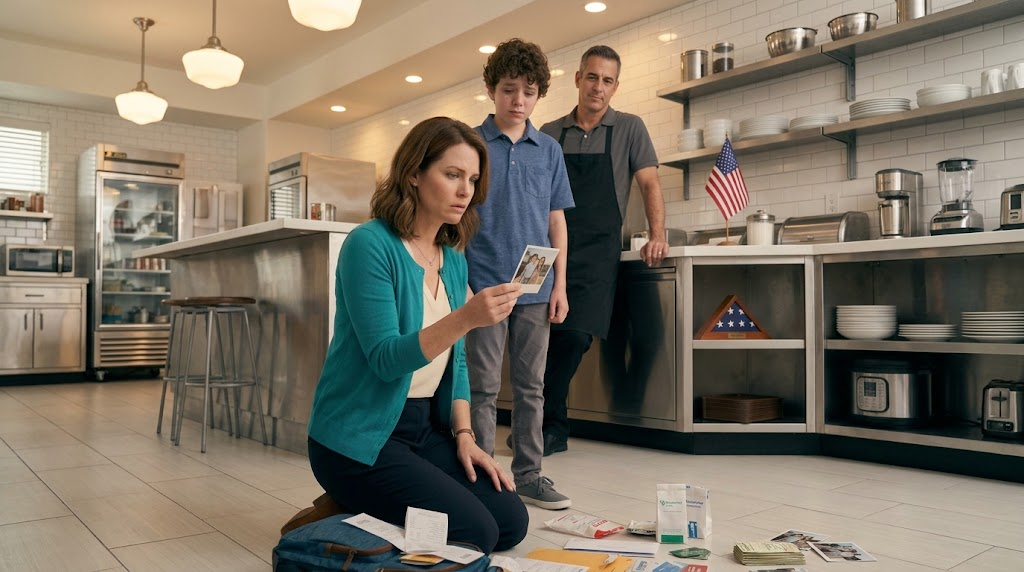
For a long moment, the only sound in the diner kitchen was the low hum of the refrigerator and the faint clatter of dishes being stacked somewhere beyond the swinging doors.
Then he whispered, “Because I knew you’d make me stop.”
The words hurt more than I expected.
“Of course I would have made you stop.”
His eyes snapped up.
“Mom—”
“You are thirteen years old, Evan. Thirteen. You have been walking through woods, crossing a creek, carrying money and medicine to people I have never met. Do you understand how dangerous that is?”
“I know.”
“No, I don’t think you do.”
His chin trembled.
“I wasn’t trying to do anything bad.”
“I know that.”
“Then why are you mad?”
“Because being kind doesn’t magically make something safe.”
He looked down again.
That silenced him.
Sal leaned against the stainless-steel counter with his arms folded.
He had known me for years. He knew when I was angry, and he knew when anger was really fear wearing a louder voice.
Right then, I was terrified.
I kept looking at the things scattered across the floor.
Pharmacy receipts.
Grocery cards.
Photographs.
Envelopes with names written on them.
MR. LEWIS.
DENISE.
CARLA.
MRS. PATTERSON.
RAY.
And beside them were stacks of cash held together with rubber bands.
I suddenly remembered finding almost three hundred dollars in Evan’s bedroom two weeks earlier.
I had been putting away clean laundry when I noticed a shoebox sticking halfway out from beneath his bed.
Inside were folded bills.
When I confronted him, he told me they were his bicycle savings.
I had believed him.
I had even apologized for snooping.
Now Sal had just told me that money had belonged to him.
I pointed toward the cash.
“Explain that.”
Sal pulled out another chair.
“I will.”
“No half-truths.”
“You have my word.”
I sat.
Evan remained across from me, looking like he wanted to disappear.
Sal rubbed a hand across his gray beard.
“When I realized what Evan was doing, I told him he wasn’t allowed to take his paycheck into those woods anymore.”
I looked at my son.
“He listened?”
Sal gave a humorless laugh.
“For approximately four days.”
Despite myself, I almost smiled.
That sounded exactly like Evan.
Sal continued.
“He started using his tip money instead.”
I closed my eyes.
“Of course he did.”
“Then he started skipping lunch.”
My eyes opened immediately.
“What?”
Evan shifted in his chair.
“Evan.”
“I wasn’t skipping every day.”
“How many days?”
Silence.
“Evan.”
“Two or three a week.”
My stomach turned.
“Why?”
He shrugged.
“I got lunch here sometimes.”
“That isn’t what I asked.”
He looked embarrassed.
“I could save another six dollars if I didn’t buy lunch at school.”
For a second, I couldn’t speak.
Six dollars.
My thirteen-year-old son had been going hungry to save six dollars for someone else.
Sal pointed at him.
“That’s where I drew the line.”
“I wasn’t starving,” Evan muttered.
“You nearly passed out carrying a box of canned goods.”
“I was tired.”
“You were hungry.”
Evan sank lower in the chair.
Sal looked back at me.
“I told him if he was determined to help, he needed to do it responsibly. So I started giving him food from here that we would otherwise throw away.”
“That part I understand.”
“And then I started giving him money.”
I frowned.
“Why?”
“Because he was giving away his own.”
I stared at Sal.
He continued before I could interrupt.
“I paid him normally. Every hour he worked, every dollar he earned. But when I saw where the money was going, I started matching some of it.”
“Matching?”
“If he bought twenty dollars in groceries, I’d give him twenty to replace it.”
“And he kept that money in his room?”
“Some of it.”
I turned toward Evan.
“Why?”
He swallowed.
“Because if you saw that I had no savings, you’d know I lied about the bike.”
I felt something inside me twist.
“So the money I saw under your bed…”
“Mostly Sal’s.”
“And you were pretending it was bicycle money.”
He nodded.
“Why not actually save it?”
He looked at me as if the answer should have been obvious.
“Because people needed it.”
I stood up and walked several steps away.
I needed distance.
Not from Evan.
From the emotion rising inside me.
I had spent six months believing my son was learning responsibility.
He had begged me for permission to work Saturday mornings at Sal’s diner.
He told me he wanted to save for a blue mountain bike he had seen at Riley’s Sporting Goods.
It cost four hundred and sixty-nine dollars.
He had shown me the picture so many times that I could still see every detail.
Black tires.
Blue frame.
Silver lettering.
Evan talked about that bicycle constantly.
He planned where he would ride it.
He watched review videos.
He had even measured a space in the garage for it.
I thought his job was about learning patience.
Turns out he had been learning something entirely different.
I turned around.
“You really still want that bike?”
His face changed.
For the first time all evening, he looked exactly thirteen.
“Yeah.”
There was almost shame in his voice.
I walked back toward the table.
“Evan, wanting something for yourself isn’t wrong.”
“I know.”
“No, I don’t think you do.”
He looked at me.
“You don’t have to feel guilty because you want a bicycle.”
“I don’t.”
“You sound guilty.”
He hesitated.
Then he whispered, “Sometimes.”
“Why?”
He looked toward the pharmacy bags.
“Because every time I got close to having enough money, something happened.”
“What do you mean?”
“Mr. Lewis needed boots.”
He began counting quietly on his fingers.
“Then Denise’s heater broke. Then Carla’s little boy got sick. Then Mrs. Patterson needed medicine. Ray’s phone stopped working and he needs it for his job applications. And then…”
His voice faded.
“And then what?”
His eyes moved toward one of the thick envelopes.
I noticed it immediately.
It was larger than the others.
EMERGENCY FUND had been written across the front in black marker.
I reached for it.
Evan moved suddenly.
“Mom, don’t.”
I stopped.
“Why?”
“It isn’t finished.”
“What isn’t finished?”
He glanced at Sal.
Sal’s expression had changed.
The older man sighed.
“Tell her.”
Evan shook his head.
“Please.”
“She deserves to know.”
I looked between them.
My heart began pounding again.
“Know what?”
Neither answered.
I picked up the envelope.
Evan reached toward it, but this time I pulled it back.
“Evan.”
His eyes filled with tears.
“Please don’t be mad.”
I opened it.
Inside was cash.
A lot of cash.
More than eight hundred dollars.
Behind the money was a folded sheet of paper.
I unfolded it.
It was a hospital estimate.
Mrs. Patterson’s name appeared at the top.
I skimmed the page.
Then my eyes stopped on a sentence circled in red.
SURGICAL INTERVENTION RECOMMENDED WITHOUT FURTHER DELAY.
My mouth went dry.
I looked at Evan.
“You were saving for her surgery?”
He shook his head.
“Not exactly.”
“What does that mean?”
“The operation is being covered.”
“Then what is this money for?”
He rubbed his eyes with the heels of his hands.
“She won’t have anywhere to recover.”
I stared at him.
Sal quietly explained.
“The roof on her trailer leaks. Badly. There’s mold in the back room, and half the floor near the bathroom is rotten.”
Evan continued.
“The hospital charity program approved her surgery, but she needs somewhere clean to stay after they discharge her.”
“And eight hundred dollars is going to fix a trailer?”
“No.”
“Then what?”
He looked frightened again.
“I was trying to rent her a motel room.”
I blinked.
“For how long?”
“Two weeks.”
I almost laughed, except nothing about this was funny.
“You’re thirteen.”
“I know.”
“You were trying to rent a motel room.”
“I was going to ask Sal.”
Sal raised a hand.
“That part is true.”
I stared at him.
“And you were going to allow this?”
“Not exactly.”
Evan groaned.
“Sal.”
“I told you we weren’t lying to her anymore.”
“What were you planning?”
Sal reached beneath the counter and pulled out a folder.
He placed it in front of me.
Inside was a list.
Names.
Dollar amounts.
Phone numbers.
Several local businesses.
I recognized a grocery store.
A pharmacy.
A hardware company.
The church three blocks from our house.
“What is this?”
Sal leaned back.
“This is where the story gets bigger.”
I looked at Evan.
His cheeks turned red.
Sal smiled slightly.
“Your son is terrible at keeping secrets once more than three adults become involved.”
Evan covered his face.
“About six weeks ago, one of my regular customers noticed him carrying grocery bags out the back door.”
“Who?”
“Mr. Donnelly.”
I knew the name.
Mr. Donnelly owned a plumbing company.
“He asked Evan what the groceries were for. Your kid tried telling him they were mine.”
“That was believable,” Evan muttered.
“It would have been if the bag didn’t have six boxes of women’s cold medicine in it.”
I almost smiled again.
Sal continued.
“So Donnelly kept asking questions. Eventually he learned about the trailer park.”
“And?”
“And he wanted to help.”
I looked down at the list.
“So did these people?”
Sal nodded.
“At first, it was just a few regulars. Somebody donated fifty dollars. Someone else brought coats. A woman who owns the laundromat offered free washing twice a month. Then the pharmacist started discounting supplies.”
I stared at the names.
“There are thirty-seven people on this page.”
“Thirty-nine now.”
I looked at Evan.
“You started this?”
He shook his head immediately.
“No.”
Sal snorted.
“He absolutely started it.”
“I didn’t ask anyone!”
“You didn’t have to.”
Evan looked uncomfortable.
“I just told them what people needed.”
“That is called starting something,” Sal said.
Evan frowned.
“I thought starting something meant you planned it.”
“Kid, almost nothing important starts because somebody planned every detail.”
I looked at my son.
Suddenly the photographs made sense.
I picked up the one of Mrs. Patterson.
“Why photographs?”
Evan looked relieved that I had asked a simpler question.
“To keep track.”
“Of what?”
“Who got what.”
He began gathering several pictures.
“This is Mr. Lewis after we got him boots.”
He handed me a photograph.
The man standing beside Evan looked thin and tired, but he was smiling broadly.
On his feet were heavy brown work boots.
“This is Denise with her grandkids.”
Another picture.
Two children stood in front of a small trailer holding grocery bags.
“This is Ray when Mr. Donnelly gave him a job interview.”
Another.
“This is Carla after the pharmacy helped with her son’s medicine.”
Picture after picture.
Names.
Dates.
Notes.
No dramatic poses.
No social media.
No signs announcing charity.
Just evidence that my son had quietly been walking into a part of town most people ignored and noticing human beings.
I swallowed.
“What does ‘Week Three’ mean on Mrs. Patterson’s photo?”
“The third week I brought her groceries.”
“And you documented everything?”
He nodded.
“Why?”
“So nobody thought I was stealing.”
The answer hit me harder than it should have.
“Who would think you were stealing?”
He shrugged.
“You might.”
I froze.
He immediately looked panicked.
“I don’t mean you would think I’m a thief.”
“Then what do you mean?”
“If you saw money missing.”
My throat tightened.
Of course.
He had known there was a chance I would discover the truth.
He had prepared proof.
Not because he feared strangers.
Because he feared disappointing me.
I sat down again.
“Evan.”
He looked at me carefully.
“I’m not angry because you helped people.”
His shoulders loosened slightly.
“I’m angry because you put yourself in danger and lied to me.”
“I know.”
“You crossed an abandoned area alone.”
“Sometimes.”
“You carried hundreds of dollars.”
“Not all at once.”
“That does not help your case.”
Sal chuckled.
I gave him a look.
He immediately stopped.
Evan whispered, “I’m sorry.”
This time, I heard it differently.
Not as a confession.
As a child who genuinely believed doing the right thing required hiding it.
I reached across the table.
“Come here.”
For half a second, he looked confused.
Then he stood.
I pulled him into my arms.
He collapsed against me so quickly that I realized how tense he had been.
“I’m sorry,” he repeated.
“I know.”
“I didn’t mean to lie.”
“You absolutely meant to lie.”
He made a tiny sound that might have been a laugh through his tears.
I rubbed his back.
“We’re going to talk about that later.”
“Okay.”
“And you are never crossing that creek alone again.”
“Okay.”
“And you are eating lunch every single day.”
He sighed.
“Okay.”
“And if I ever find out you skipped lunch to buy someone socks, I will personally follow you to school with a sandwich.”
Sal laughed.
Evan groaned.
“Mom.”
“I am serious.”
“I know.”
I held him for another few seconds.
Then I let go.
I looked at the hospital estimate.
“When is Mrs. Patterson’s surgery?”
“Tuesday.”
That was four days away.
“And where is she supposed to recover?”
Evan’s face fell.
“That’s the problem.”
Sal tapped the folder.
“We have motel money.”
“How much?”
“With the eight hundred there and what people promised? Almost twelve hundred.”
“That gets her two weeks.”
“Maybe three if the owner works with us.”
“And after that?”
Sal shrugged.
“Her trailer is still falling apart.”
I looked at Evan.
He was staring at the folder.
I knew that look.
He already had a plan.
“What are you thinking?”
“Nothing.”
“Evan.”
He hesitated.
“We could fix it.”
Sal immediately shook his head.
“No.”
“Why?”
“Because the place needs more than a few boards.”
“We don’t know that.”
“Yes, we do.”
“Mr. Donnelly said—”
“Mr. Donnelly said the bathroom floor might be fixable.”
“And the roof.”
“He said part of the roof.”
“That’s most of it.”
“That is not most of a trailer.”
I raised my hand.
“Stop.”
They both stopped.
I stared at them.
“How bad is this trailer park?”
Neither answered.
I grabbed my coat.
“Show me.”
Evan’s eyes widened.
“Now?”
“Yes.”
“It’s dark.”
“Exactly.”
“But—”
“You’ve apparently walked there in worse conditions.”
Sal glanced at the clock.
“I can drive us.”
“No.”
He looked surprised.
“We’re walking.”
Evan stared at me.
“Why?”
“Because I want to see exactly what you’ve been doing.”
Twenty minutes later, I understood.
The path began behind the diner parking lot.
It dropped through a narrow line of woods, crossed a shallow creek over two warped boards, then climbed toward an old road mostly hidden by weeds.
I nearly slipped twice.
Evan moved through the darkness like he knew every root.
That frightened me more than anything.
“How many times have you done this?”
He pretended not to hear.
“Evan.”
“A lot.”
The trailer park appeared beyond a line of trees.
Most of the streetlights were broken.
Several trailers were dark.
One had a tarp covering half the roof.
Another had plywood where a window should have been.
Yet I saw signs of life everywhere.
A porch light.
Laundry hanging beneath an awning.
A child’s plastic truck.
A bicycle with one missing wheel.
A row of potted plants sitting beside a cracked set of steps.
Evan led us toward a small white trailer.
Before we reached it, the door opened.
An elderly woman stepped outside.
She wore a thick sweater and held onto the railing.
“Evan?”
My son raised a hand.
“Hi, Mrs. Patterson.”
She smiled.
Then she noticed me.
The smile vanished.
“Oh.”
I stepped forward.
“You must be Mrs. Patterson.”
She looked at Evan.
“You finally told your mother?”
“Not exactly.”
Sal laughed behind us.
“He got caught.”
Mrs. Patterson covered her mouth.
Then, unexpectedly, she started laughing.
It was warm and delighted.
“Well,” she said, “that sounds more like him.”
I looked at Evan.
“How many people here knew you were lying to me?”
He studied the ground.
“Probably everybody.”
“Fantastic.”
Mrs. Patterson reached for my hand.
“You should know something.”
“What?”
“That boy has been one of the greatest blessings this place has seen in years.”
Evan immediately shook his head.
“Mrs. Patterson…”
“It’s true.”
She squeezed my hand.
“He came here carrying soup in a diner bag. That was all.”
Her eyes moved toward him.
“And somehow that turned into people remembering we exist.”
I looked around.
“Why are people still living here?”
Her expression changed.
“Because life gets expensive faster than people expect.”
She didn’t say it bitterly.
That made it worse.
She pointed toward the trailers.
“Some are waiting for housing assistance. Some are working. Some are old. Some made mistakes. Some got sick. Some simply ran out of luck.”
She looked back at me.
“Your son never asked which kind we were.”
My eyes burned.
Mrs. Patterson turned toward Evan.
“He just asked what we needed.”
A man approached from the next trailer.
I recognized him from the photograph.
Mr. Lewis.
He was wearing the brown boots.
“Well, there’s the troublemaker.”
Evan smiled.
“Hi, Mr. Lewis.”
The man looked at me.
“You his mom?”
“Yes.”
“You raised a good one.”
I glanced at Evan.
“I’m beginning to hear that.”
Mr. Lewis laughed.
Within minutes, several people had come outside.
Denise.
Ray.
Carla.
Two small children.
Each person knew Evan.
Not casually.
They knew his favorite soda.
They knew he hated mushrooms.
They knew he was saving for a bicycle.
That surprised me.
“Wait.”
I looked at Denise.
“You knew about the bike?”
“Of course.”
I turned toward Evan.
“You told them?”
He looked embarrassed.
“Mr. Lewis saw the picture on my phone.”
The older man nodded.
“And we told him to stop spending his bicycle money on us.”
Evan shoved his hands into his pockets.
“They needed things.”
Denise crossed her arms.
“And you need a bicycle.”
“Not the same.”
“No,” she said. “It isn’t.”
Her voice softened.
“But needing joy counts too.”
Evan didn’t answer.
I remembered telling him almost the same thing an hour earlier.
Mrs. Patterson invited us inside.
The trailer was clean.
Painfully clean.
The kind of clean that comes from someone fighting to preserve dignity even when the building around them is failing.
A bucket sat beneath a brown water stain.
The floor near the bathroom dipped noticeably.
Plastic covered one window.
Yet a crocheted blanket lay neatly across the couch.
Family photographs lined a shelf.
There were two mugs drying beside the sink.
I suddenly understood what Evan had seen.
Not “poor people.”
Homes.
Lives.
People trying to hold onto ordinary things.
Mrs. Patterson handed me tea.
“I didn’t want him paying for that motel.”
“I’m glad to hear at least one adult here has sense.”
She laughed.
“He argued.”
“That also sounds like him.”
“He told me recovery mattered.”
“He’s right about that.”
“He usually is, which is annoying.”
Evan smiled.
Then she said something that changed everything.
“He told me he wished he could fix the trailer instead.”
I looked at him.
He froze.
Mrs. Patterson continued.
“Then Mr. Donnelly came by.”
Sal groaned softly.
I turned.
“What?”
He rubbed his forehead.
“You might as well hear the rest.”
“There’s more?”
“There is always more with your son.”
The next morning, I called Mr. Donnelly.
He met me at the trailer park with two employees.
For nearly an hour, they inspected Mrs. Patterson’s home.
When he came out, he gave me the truth.
“The bathroom subfloor needs replacement. Roof has two bad sections. There’s some mold damage, but it hasn’t spread as far as I expected.”
“How much?”
“If you hired everything out normally?”
He named a number that made my stomach drop.
We didn’t have it.
Not even close.
Then he smiled.
“But that’s not what I asked.”
I frowned.
He pointed toward his truck.
“My guys volunteered Saturday.”
“What?”
“Materials are the issue.”
Before I could answer, another truck pulled into the lot.
Then another.
Sal stepped from the second one carrying coffee.
Behind him came the owner of the local hardware store.
Then the pharmacist.
Then a man from the church.
Then two women I recognized as diner regulars.
Evan stood beside me, equally confused.
“What’s happening?”
Sal handed me coffee.
“Your son made the mistake of being helpful in a town full of nosy people.”
Within twenty minutes, I learned that the hardware store was donating lumber.
The church had leftover roofing materials.
Mr. Donnelly’s crew would do plumbing and flooring.
Another diner customer knew mold remediation.
Someone else had an unused portable heater.
The motel owner still offered a room for Mrs. Patterson during recovery.
Nobody had organized all of them.
Not exactly.
They had simply heard.
One person told another.
A boy quietly spent his paycheck helping someone.
A diner owner matched him.
A customer joined.
Then another.
Then another.
And suddenly kindness had acquired momentum.
Evan stood completely speechless.
Mr. Lewis walked toward him.
“Looks like your emergency fund just became unnecessary.”
Evan looked at the envelope in his hand.
“What happens to the money?”
Mrs. Patterson answered immediately.
“You keep it.”
He stared at her.
“What?”
“For your bicycle.”
“No.”
Everyone laughed.
“I’m serious.”
“So are we,” Denise said.
“I didn’t earn this for me.”
Mr. Lewis shook his head.
“That’s where you’re wrong.”
Evan looked genuinely distressed.
“No.”
I stepped beside him.
“Why not?”
“Because…”
He looked around.
“There are still people who need stuff.”
“There always will be.”
“That’s my point.”
“No,” I said quietly. “That’s mine.”
He looked at me.
“If you wait until nobody needs anything before allowing yourself to have something, Evan, you will spend your entire life feeling guilty for being happy.”
He said nothing.
I put my hand on his shoulder.
“You are allowed to help people.”
His eyes dropped.
“And you are allowed to have a bicycle.”
Mrs. Patterson smiled.
“Listen to your mother.”
He looked at her suspiciously.
“You all planned this.”
Sal coughed.
Nobody answered.
Evan narrowed his eyes.
“You did.”
That afternoon, I learned just how much planning had happened.
The money in the emergency fund wasn’t all Evan’s.
Sal had put in two hundred.
Mr. Donnelly added one hundred.
Several customers had added smaller amounts.
They had intended it for Mrs. Patterson.
Once her recovery and repairs were covered through donations, every one of them agreed that Evan should get back the portion he had contributed.
Evan refused.
Then they argued with him for almost an hour.
He still refused.
Eventually Mrs. Patterson solved the problem.
She pointed a finger at him.
“Boy, if you make an old woman recovering from surgery stand here arguing with you, I am going to be furious.”
Evan blinked.
Her surgery had not even happened yet.
“You’re not recovering.”
“I’m practicing.”
Everyone laughed.
Even Evan.
The following Tuesday, Mrs. Patterson had her operation.
I drove her to the hospital.
Evan came with me.
For the first time, he didn’t have to hide anything.
He carried her bag.
I carried the paperwork.
Sal brought breakfast.
When the nurse wheeled Mrs. Patterson through the double doors, she grabbed Evan’s hand.
“Thank you.”
He looked uncomfortable.
“For what?”
“For noticing.”
Those two words stayed with me.
For noticing.
That was what he had done.
Before the groceries.
Before the medicine.
Before the money.
Before the photographs.
He had noticed.
And maybe that was the rarest part.
The world wasn’t short on people who cared.
It was short on people who slowed down long enough to see where caring was needed.
Mrs. Patterson spent twelve days recovering at the motel.
During that time, her trailer transformed.
The bathroom floor was rebuilt.
The roof stopped leaking.
The mold was removed.
A contractor replaced damaged wall panels.
Someone donated a small refrigerator.
The church ladies brought curtains.
Denise cried when volunteers repaired her steps too.
Then someone fixed Ray’s broken window.
Then Carla’s heater.
The project expanded beyond Mrs. Patterson’s trailer.
By the end of the month, volunteers had repaired five homes.
I kept waiting for the enthusiasm to disappear.
It didn’t.
Instead, Sal placed a glass jar beside the diner register.
COMMUNITY FUND.
Underneath, in smaller letters:
STARTED BY A KID WHO WOULDN’T MIND HIS OWN BUSINESS.
Evan hated the sign.
Customers loved it.
Within three weeks, the jar collected over fourteen hundred dollars.
Sal opened a separate account.
This time, adults managed it.
Evan was allowed to make suggestions.
He was not allowed to carry cash through the woods.
That was one of my nonnegotiable rules.
My second rule was that every visit to the trailer park required an adult.
My third was lunch.
Always lunch.
No exceptions.
Evan complained about all three.
Then obeyed them.
Mostly.
A month after I discovered the backpack, we were eating breakfast when Evan slid a piece of paper across the table.
“What’s this?”
He looked unusually nervous.
“My savings.”
I opened it.
It was a handwritten list.
DINER PAYCHECKS: $312
TIPS: $96
RETURNED EMERGENCY MONEY: $173
BIRTHDAY MONEY: $80
TOTAL: $661
I looked up.
“You have enough.”
He nodded.
The blue bicycle cost less than five hundred.
“You could have bought it weeks ago.”
“I know.”
“Why haven’t you?”
He moved cereal around his bowl.
“I don’t know.”
I did.
He still felt guilty.
I stood.
“Get your coat.”
“What?”
“Coat.”
“Where are we going?”
“To buy your bike.”
His eyes widened.
“Now?”
“Yes.”
“But I work at ten.”
“It’s eight.”
“Riley’s doesn’t open until nine.”
“We’ll be their first customers.”
He hesitated.
Then came the last attempt.
“Mom, Mrs. Patterson still needs—”
“Her refrigerator works.”
“Mr. Lewis—”
“Has boots.”
“Denise—”
“Got heating assistance.”
“Carla—”
“Has enough grocery cards for six weeks.”
“Ray—”
“Starts his new job Monday.”
Evan stared at me.
I smiled.
“Nice try.”
At nine-oh-two, we walked into Riley’s Sporting Goods.
The bicycle was still there.
Same blue frame.
Same black tires.
Same silver lettering.
Evan stood in front of it without touching it.
The employee came over.
“Want to take it down?”
Evan swallowed.
“Yes.”
When he sat on the bicycle, something happened to his face.
He became thirteen again.
Not a volunteer.
Not a fundraiser.
Not the boy carrying medicine through the woods.
Just a kid sitting on the bicycle he had wanted for nearly a year.
He rode a small circle through the testing area.
I hadn’t seen him smile that widely in months.
“How does it feel?”
“Amazing.”
“Then buy it.”
He did.
With his own money.
At the register, the cashier told him the total.
Evan carefully counted bills from an envelope.
I watched every dollar leave his hand.
For once, it was going toward him.
I felt strangely proud of that too.
When we carried the bicycle outside, a truck horn suddenly blasted.
Evan jumped.
Then another horn sounded.
And another.
I looked toward the parking lot.
Sal was there.
So was Mr. Donnelly.
Mrs. Patterson stood beside Denise.
Mr. Lewis leaned against a pickup.
Carla had brought her son.
Even Ray was there.
Evan looked horrified.
“You told them?”
I raised both hands.
“I did not.”
Sal grinned.
“The kid who works the register texted me.”
“You people are unbelievable.”
Mrs. Patterson walked forward carrying a small package.
“This is from all of us.”
Evan immediately protested.
“No.”
She gave him the same look she had used at the trailer park.
He accepted the package.
Inside was a bicycle helmet.
On the side, someone had placed a small sticker.
It read:
NOTICE PEOPLE.
Evan stared at it.
Then his eyes filled.
He quickly looked away.
Mr. Lewis cleared his throat.
“Helmet’s required.”
“I know.”
“And no riding through the creek.”
My son looked at me.
I crossed my arms.
“That rule came from me.”
He groaned.
Everyone laughed.
For the next several months, life settled into something different.
Evan kept working at the diner.
He still donated money sometimes.
But now there were limits.
Ten percent of each paycheck went into the community fund if he wanted.
The rest belonged to him.
At first, he hated the rule.
Eventually, he understood why I made it.
Generosity wasn’t supposed to mean disappearing.
Helping others shouldn’t require treating yourself as if your own needs didn’t matter.
He needed to learn that before kindness became another way of hurting himself.
The community fund grew.
People began leaving more than cash.
Job listings.
Unused furniture.
Gift cards.
Bus passes.
Coats.
School supplies.
A retired social worker volunteered to help people apply for housing and benefits.
That mattered more than almost anything.
Because the goal was never to keep bringing bags forever.
The goal was helping people reach a place where they no longer needed a thirteen-year-old carrying groceries through the woods.
Ray became the first.
He got the warehouse job Mr. Donnelly had helped him apply for.
Three months later, he moved into a small apartment.
On moving day, he stopped by the diner.
Evan was wiping tables.
Ray placed an envelope on the counter.
“What’s this?” Evan asked.
“My first donation.”
Evan shook his head.
“You don’t have to.”
Ray smiled.
“I know.”
Inside was twenty dollars.
Evan stared at it.
Ray said, “Somebody helped me when I needed it. Now I help somebody else.”
That night, Evan came home unusually quiet.
We sat at the kitchen table.
He finally said, “I think I get it now.”
“Get what?”
“Why you made me keep money.”
I smiled.
“Really?”
“If everybody gives until they have nothing, then everybody eventually needs help.”
“That’s one way of putting it.”
He thought about that.
“So helping has to be sustainable.”
I raised an eyebrow.
“Where did you learn that word?”
“Sal.”
“Of course.”
He smiled.
Then he asked, “Are you still mad I lied?”
I considered pretending I wasn’t.
Instead, I told the truth.
“A little.”
He nodded.
“I deserved that.”
“But I understand why you did.”
“I thought you’d say no.”
“I probably would have.”
He looked surprised.
“At first.”
“Why?”
“Because I would have been scared.”
“You were scared anyway.”
“Yes.”
He smiled.
“So technically telling you wouldn’t have changed that.”
“Careful.”
He laughed.
I reached across the table and squeezed his hand.
“But if you had told me, maybe we could have helped together.”
His smile faded.
“I didn’t think about that.”
“I know.”
That might have been the biggest lesson for both of us.
Evan thought asking adults would end what he was doing.
Instead, once adults knew, the help multiplied.
The secret had made him responsible for everything.
The truth spread the responsibility.
Nearly a year passed.
The abandoned trailer park was no longer invisible.
Some residents had moved into permanent housing.
Others remained.
Several trailers had been repaired enough to be safe.
The county finally addressed the damaged road after dozens of residents and volunteers attended a public meeting.
The church began operating a food pantry twice a month.
The diner still donated leftovers.
And Evan still crossed the creek.
But never alone.
Usually I went with him.
Sometimes Sal.
Sometimes volunteers.
And sometimes Evan rode his blue bicycle as far as the path allowed, chained it to a tree, then walked the rest of the way.
One Saturday morning, almost exactly a year after the secret began, I found him sitting outside Mrs. Patterson’s trailer.
She was beside him.
They were looking at something.
As I got closer, I realized it was the old stack of photographs.
Mrs. Patterson held the first picture.
The one I had found on the diner kitchen floor.
Her standing beside the tiny white trailer.
Evan holding groceries.
Mrs. Patterson — Week Three.
She smiled.
“You were so skinny.”
Evan laughed.
“I still am.”
“You looked terrified.”
“I thought Mom was going to find out.”
“I eventually did.”
They turned.
I stood behind them with my arms crossed.
Evan smiled.
“That worked out okay.”
“Depends who you ask.”
Mrs. Patterson patted the seat beside her.
I sat.
Evan handed me the photograph.
The trailer behind them looked different now.
The roof had been repaired.
The porch railings were painted.
There were flowers beneath the front window.
I looked at the picture.
Then at the real house.
“Hard to believe.”
Mrs. Patterson nodded.
“Not because of the repairs.”
“What then?”
She pointed at Evan.
“Because that child thought he needed to do all of this alone.”
He looked embarrassed.
“I didn’t think I needed to.”
“Yes, you did.”
He shrugged.
“I just started.”
Mrs. Patterson smiled.
“That’s usually how things happen.”
We sat quietly for a while.
Then Evan suddenly stood.
“I have work.”
“You’re going to be late,” I said.
“I know.”
He grabbed his backpack.
The same backpack that had spilled open on the diner floor a year earlier.
Now there were no hidden envelopes inside.
No secret pharmacy receipts.
No stacks of mysterious cash.
He slung it over his shoulders.
Then he jogged toward his bicycle.
“Helmet!” I shouted.
He stopped.
Groaned.
Returned to the porch.
Picked up the helmet.
Mrs. Patterson laughed so hard she started coughing.
Evan put it on.
The little sticker was still there.
NOTICE PEOPLE.
He fastened the strap.
“You happy?”
“Very.”
He climbed onto his bicycle and rode away.
Mrs. Patterson watched him disappear beyond the trees.
“You know,” she said quietly, “that boy is going to do something extraordinary one day.”
I smiled.
“He already did.”
She looked at me.
I shook my head.
“Not the money.”
Not the groceries.
Not the repairs.
Not the medicine.
Not even the community fund that had now helped dozens of families.
The extraordinary thing had happened before any of that.
A thirteen-year-old boy working in the back of a diner had seen an older man searching through trash for aluminum cans.
Most people would have looked away.
Evan asked whether he was hungry.
That question changed everything.
Mr. Lewis got dinner.
Then Denise got groceries.
Mrs. Patterson got medicine.
Carla got help for her son.
Ray got a job.
A trailer got repaired.
Then another.
People who had stopped believing anyone saw them discovered that somebody did.
And my son?
He learned something too.
He learned that kindness does not require secrecy.
That compassion doesn’t mean sacrificing every piece of yourself.
That asking for help can sometimes help more people than trying to carry everything alone.
And I learned perhaps the most humbling lesson of all.
I had spent years believing my job was to teach Evan how to become a good person.
Responsibility.
Honesty.
Patience.
Hard work.
I never imagined that one day I would be sitting beside an elderly woman outside a repaired trailer, realizing my thirteen-year-old had been teaching me something too.
Pay attention.
Ask questions.
Don’t assume somebody else will help.
And when you can do something, even something small, do it.
Months later, Sal replaced the handwritten sign beside the donation jar.
The new one was framed.
COMMUNITY FUND.
And underneath:
IT STARTED WITH ONE LEFTOVER BOWL OF SOUP.
Customers sometimes asked what that meant.
Sal loved telling the story.
He exaggerated certain parts.
According to him, Evan had practically founded a nonprofit before finishing middle school.
Evan hated when he did that.
“Stop telling people about me,” he would complain.
Sal always gave the same answer.
“I’m not telling them about you.”
“Yes, you are.”
“I’m telling them what happened.”
“That’s the same thing.”
“No, kid.”
Sal would point toward the donation jar.
“The important part isn’t that you helped.”
Evan would roll his eyes.
“Then what is?”
“That somebody else might hear the story and decide to help too.”
Evan never had a comeback for that.
Neither did I.
And maybe that is why I’m telling this story now.
Not because my son was perfect.
He wasn’t.
He lied.
He scared me half to death.
He skipped lunch.
He ignored common sense.
He crossed a dangerous creek alone.
He hid money under his bed.
And he nearly gave away every dollar he earned.
But buried inside all those mistakes was something worth protecting.
He cared.
Deeply.
Sometimes recklessly.
And instead of punishing the caring out of him, the adults around him eventually helped give it structure.
That, I think, made all the difference.
A few weeks before Evan turned fifteen, we were driving home from the diner when we passed Riley’s Sporting Goods.
A new bicycle sat in the window.
Bright red.
More expensive than his old one.
Evan looked at it.
I noticed.
“You like it?”
He shrugged.
“It’s nice.”
“Want to start saving?”
He thought for a moment.
Then smiled.
“Maybe.”
I laughed.
“Please tell me that means you are actually going to save this time.”
“No promises.”
“Evan.”
“I’m joking.”
“You’d better be.”
He looked out the window.
Then said something so quietly I nearly missed it.
“I like mine better anyway.”
“The blue one?”
“Yeah.”
“Why?”
He smiled.
“Because I know where it came from.”
I understood.
The bicycle had not simply come from his paycheck.
It came from learning when to give.
When to accept.
When to ask.
And when to let other people care about you too.
I reached over and squeezed his shoulder.
He pretended to be annoyed.
He was almost fifteen, after all.
But he didn’t pull away.
And when we reached home, he parked that blue bicycle carefully in the garage.
Right in the space he had measured for it years earlier.
The place had waited for him all along.
He just needed to learn that he was allowed to fill it.
💬THE END! THANK YOU FOR READING!