

“Daddy’s snake bites me,” the little girl cried to 911, but when police kicked the door down, they discovered the monster had no scales, only a human face.
At first, 911 operator Claire Johnson thought the eight-year-old was talking about an animal.
Maybe a pet python had escaped from a cage.
Maybe a snake had slipped beneath the bed.
Maybe something with scales and sharp teeth had found its way inside through an open basement window.
Children often struggled to explain emergencies.
They described smoke as “black clouds,” seizures as “shaking sickness,” and unconscious people as “sleeping wrong.”
Claire had learned never to assume that the words a child used meant exactly what an adult would mean by them.
Still, her first instinct was simple.
Find out where the snake was.
“911, what’s your emergency?”
The child’s breathing came through the headset in small, trembling bursts.
“Daddy’s snake.”
Claire leaned toward the microphone.
“Okay, sweetheart. Is the snake near you right now?”
A pause.
Then the girl whispered, “It’s so big.”
Claire’s fingers moved across the keyboard.
Possible animal attack.
Child caller.
She began entering the information.
“Did it bite you?”
The child whimpered.
“Yes.”
Claire’s hand stopped.
“Are you bleeding?”
“I don’t know.”
“What’s your name?”
“Emily.”
“All right, Emily. My name is Claire. I’m going to help you.”
Emily sniffed.
“Promise?”
“I promise I’ll do everything I can.”
There was another pause.
Then the sentence that changed the entire call.
“Daddy says it’s our secret.”
Claire sat completely still.
Her supervisor, Mark, looked across the dispatch room when he noticed her expression.
Claire raised two fingers.
Their silent signal for a supervisor to listen in.
Mark slipped on a spare headset.
Claire kept her voice gentle.
“Emily, when you say Daddy’s snake, is it a real animal?”
The child said nothing.
Claire waited.
She could hear what sounded like a blanket shifting.
“Sweetheart?”
“No.”
Claire’s stomach tightened.
“What does Daddy mean when he says snake?”
“He says it wakes up when I’m bad.”
Mark’s face changed.
Claire immediately updated the call.
POSSIBLE CHILD ABUSE.
ADULT MALE IN RESIDENCE.
IMMEDIATE RESPONSE.
“What happens when the snake wakes up?”
Emily began crying again.
“I don’t wanna say.”
“That’s okay. You don’t have to tell me anything that makes you scared. I just need to know if you’re safe right now.”
“I’m in my room.”
“Is Daddy in the room?”
“No.”
“Where is he?”
“Downstairs.”
Claire entered the address that automatically populated on her screen.
1427 Maplewood Drive.
Springfield, Illinois.
“Is your bedroom door closed?”
“Yes.”
“Locked?”
“No.”
“Can you lock it without making noise?”
“He’ll hear.”
“Then don’t.”
Claire looked at the dispatch clock.
9:15 p.m.
Units were already being assigned.
Officers Daniel Harris and María López were less than four minutes away.
Claire knew four minutes could feel like an hour to a frightened child.
“Emily, are you hiding?”
“Under my blanket.”
“Do you have the phone with you?”
“Yes.”
“Where did you get it?”
“Kitchen drawer.”
“Does Daddy know you have it?”
“No.”
“Okay. Keep it with you.”
Emily inhaled shakily.
“Is Mommy coming?”
“Where is Mommy?”
“At work.”
“What kind of work does she do?”
“Hospital.”
Claire typed that down too.
“Does Daddy know you called 911?”
“No.”
Then they both heard it.
A door downstairs.
Claire’s body went tense.
Emily stopped breathing for a moment.
Footsteps crossed a hard floor.
Slow.
Heavy.
One step.
Another.
Then the stairs creaked.
Emily whispered, “He’s coming.”
Claire’s voice remained calm.
“Okay. Don’t hang up.”
“He’s gonna know.”
“Put the phone somewhere he can’t see it.”
Fabric rustled.
The sound became muffled.
Emily had probably shoved the phone beneath a pillow or blanket.
Claire heard the upstairs floor creak.
Then a man’s voice.
“Emily?”
Claire stared at the screen.
Mark immediately sent another message to responding officers.
MALE NOW NEAR CHILD.
The voice came again.
“Emily, why is your light on?”
No answer.
“Emily.”
The bedroom door opened.
Claire heard it.
She heard Emily’s shaky breathing.
Then the man’s voice became closer.
“Were you downstairs?”
“No.”
“Are you lying to me?”
“No.”
“You know what happens when you lie.”
Emily made a tiny sound.
Claire’s heart slammed against her ribs.
She pressed the radio button.
“Unit 12, adult male is currently in the child’s bedroom. Approach immediately. Child caller may be unable to speak.”
Officer Daniel Harris answered.
“Copy. Thirty seconds out.”
Claire glanced at the digital clock.
9:18.
She listened.
The man spoke again.
“What’s under your pillow?”
Emily suddenly cried, “Nothing!”
The phone moved.
A sharp burst of static filled Claire’s headset.
The man said, “Give me that.”
Emily screamed.
The line went silent.
Not disconnected.
Silent.
Claire’s entire body went cold.
Daniel and María turned onto Maplewood Drive.
No sirens.
No flashing lights until the final approach.
Daniel had been a police officer for eleven years.
María had been one for six.
Neither spoke much during the last few seconds.
Dispatch had already told them enough.
Child caller.
Possible abuse.
Father inside room.
Emergency line open.
Daniel slowed near the white two-story house at the end of the street.
A porch light glowed above the front door.
A plastic bicycle lay near the garage.
A swing moved in the backyard breeze.
The lawn was recently cut.
There were flowerpots beneath the front windows.
It looked painfully ordinary.
María stepped out first.
Daniel came around the other side.
They moved quickly toward the porch.
María knocked hard.
“Police department!”
Nothing.
Daniel looked at the upstairs windows.
One curtain moved.
María knocked again.
“Police department! Come to the door.”
They heard movement inside.
A lock clicked.
The door opened.
Thomas Miller stood under the porch light.
He was around forty.
Broad shoulders.
Short brown hair.
Faded construction-company T-shirt.
He wore an expression halfway between confusion and mild irritation.
“Officers?”
María kept her posture neutral.
“We received a 911 call from this residence.”
Thomas frowned.
“From here?”
“Yes.”
“That’s strange.”
“Do you have a child inside?”
“My daughter.”
“What’s her name?”
“Emily.”
“How old is she?”
“Eight.”
Daniel watched Thomas’s face.
“We need to speak with her.”
Thomas let out a small laugh.
“She’s asleep.”
María did not smile.
“We spoke with a child named Emily less than two minutes ago.”
For a fraction of a second, Thomas’s eyes changed.
It happened so quickly someone less experienced might have missed it.
Then the concerned-father expression returned.
“She has nightmares.”
Daniel glanced past him.
The staircase was visible from the front door.
A hallway light burned upstairs.
“We need to see her.”
Thomas shifted.
“I don’t really appreciate officers waking my daughter because she played with a phone.”
“She reported being frightened.”
“She gets frightened by everything lately.”
“Step aside.”
Thomas did not move.
“I’m not trying to be difficult, but you can’t just come into my house.”
Then a noise came from above.
A small whimper.
Every officer heard it.
Thomas looked toward the stairs.
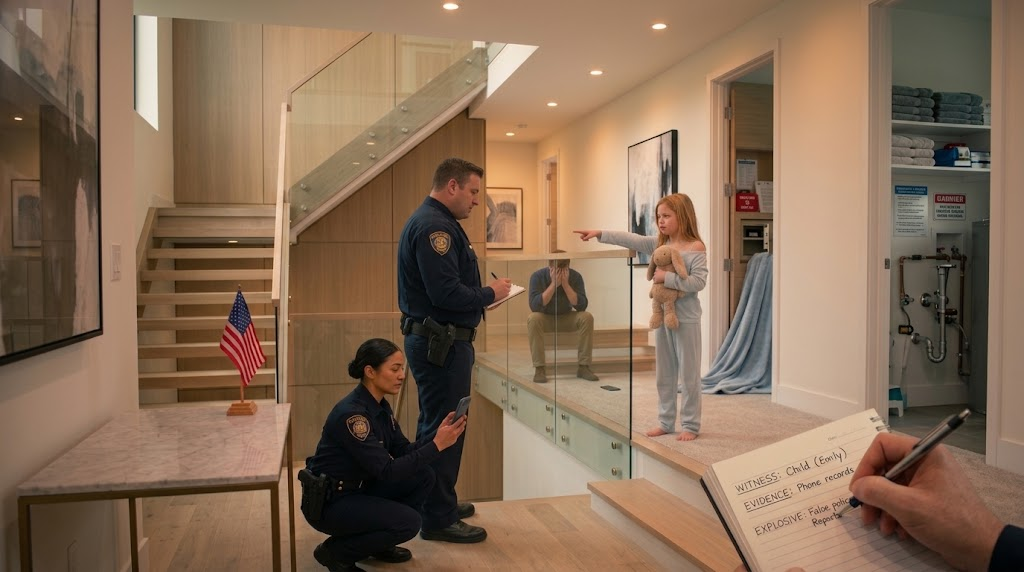
At the top stood Emily.
She wore pink pajamas.
Her hair was tangled.
Her face was red from crying.
A stuffed rabbit hung from one hand.
The other hand trembled at her side.
“Emily,” Thomas said.
The word was quiet.
The child flinched.
María immediately stepped forward.
“Emily, sweetheart, I’m Officer López.”
Thomas turned.
“She’s fine.”
María ignored him.
“You called us, didn’t you?”
Emily’s eyes moved from María to Daniel.
Then to her father.
Her lower lip shook.
Thomas spoke without turning around.
“Go back to bed.”
Emily froze.
Daniel moved fully into the doorway.
Thomas noticed.
“You need to leave.”
“No,” Daniel said.
Thomas’s expression hardened.
María looked at Emily.
“You’re not in trouble.”
Emily began crying again.
Thomas stepped toward the staircase.
Daniel blocked him.
“Stay where you are.”
“This is ridiculous.”
“Stay where you are.”
Claire’s voice suddenly came across Daniel’s radio.
“Unit 12, caller stated, quote, ‘Daddy says it’s our secret.’”
Thomas looked at the radio.
Then at Emily.
This time his expression did not recover fast enough.
The warmth disappeared.
His jaw tightened.
Emily raised one trembling hand.
She pointed behind her.
Toward the upstairs hallway.
María followed the gesture.
A bedroom door stood partly open.
A pink blanket lay dragged across the carpet.
Near the doorway, a small phone rested facedown.
Its screen glowed.
The emergency call was still connected.
Daniel moved toward the stairs.
Thomas grabbed his arm.
“You’re not going up there.”
Daniel spun around.
“Take your hand off me.”
Thomas held on.
María stepped between Thomas and the staircase.
“Sir, back up.”
“You don’t have a warrant.”
“We have an emergency involving a child.”
“She’s lying!”
The words exploded out of him.
Emily recoiled.
Daniel grabbed Thomas’s wrist.
“Hands behind your back.”
Thomas jerked away.
María moved fast.
Together, the officers forced Thomas against the wall.
“Stop resisting.”
“You have no idea what you’re doing!”
Daniel secured one wrist.
Then the other.
Emily started down the stairs.
Slowly.
María released Thomas to Daniel and climbed toward her.
“Come to me.”
Emily hesitated.
“Daddy says police take bad children away.”
María’s expression softened.
“We don’t take children away for telling the truth.”
Emily looked at Thomas.
He stared back.
“Emily,” he said.
María turned sharply.
“Do not speak to her.”
Emily ran down the remaining steps.
She hit María with enough force that María had to catch the railing.
Then the child wrapped both arms around her.
“I’m sorry,” Emily sobbed.
“You have nothing to be sorry for.”
“I told.”
“That was the right thing to do.”
Thomas laughed bitterly.
“She makes things up.”
Daniel pushed him toward a chair.
“Sit.”
“She wants attention.”
“Sit down.”
“You should ask her mother. She’s always having tantrums.”
Emily buried her face against María.
“Please don’t let him take me upstairs.”
“He won’t.”
Daniel looked up.
“What’s upstairs?”
Emily whispered, “The snake room.”
Thomas went still.
Daniel stared at him.
“What did she say?”
Emily looked toward the hallway.
“My room.”
María crouched.
“Emily, is anyone else in the house?”
Emily nodded.
Thomas snapped, “No, there isn’t.”
Daniel turned.
“I wasn’t asking you.”
Emily whispered, “A girl.”
María felt cold spread through her chest.
“What girl?”
“Sophie.”
Thomas immediately stood.
Daniel forced him back down.
“Where is Sophie?” Daniel asked.
Emily pointed toward the kitchen.
“Downstairs.”
“The basement?”
She nodded.
Thomas raised his voice.
“She’s confused! There is nobody in the basement.”
Emily covered her ears.
María guided her outside.
Daniel radioed for backup.
Within two minutes, more officers arrived.
One took custody of Thomas.
Another secured the first floor.
Daniel found the basement door beside the kitchen.
It was locked from the outside.
He looked at Thomas.
“Key.”
“I lost it.”
“When?”
“I don’t know.”
Daniel stared at him.
Thomas looked away.
The officers forced the lock.
The basement staircase disappeared into darkness.
Daniel switched on his flashlight.
“Police department!”
Nothing.
He descended.
Two officers followed.
The basement looked ordinary at first.
Workbench.
Tools.
Storage containers.
Christmas decorations.
An old washing machine.
Daniel swept the flashlight across the room.
“Police!”
A faint noise came from the far wall.
Daniel stopped.
Three taps.
Knock.
Knock.
Knock.
He moved toward the sound.
Behind several shelves was another door.
Locked.
Daniel called out.
“Is somebody in there?”
Silence.
Then a tiny voice.
“Yes.”
Daniel’s pulse jumped.
“What’s your name?”
“Sophie.”
One officer immediately radioed upstairs.
They forced the second door.
Inside the small storage space sat a girl around nine years old.
She was curled against the wall.
Her shoes were gone.
Her cheeks were wet with tears.
Daniel crouched several feet away.
“My name is Officer Harris.”
Sophie stared at him.
“Is he gone?”
“The man upstairs is with police.”
“Emily?”
“She’s safe.”
Sophie’s whole face crumpled.
“She called?”
“Yes.”
Daniel removed his jacket.
“Can I put this around you?”
Sophie nodded.
He draped it over her shoulders.
“We’re going upstairs now.”
“I want my mom.”
“We’re finding her.”
Sophie stood unsteadily.
Daniel held out his hand.
She took it.
Upstairs, Emily sat on the porch beside María while paramedics checked her.
When Sophie appeared through the doorway, Emily stood so fast the blanket around her shoulders fell.
“Sophie!”
Sophie ran toward her.
The girls collided in a tight embrace.
“You called,” Sophie cried.
“I called.”
“I heard them.”
“I told them where you were.”
Sophie clung to her.
Thomas watched from the back seat of a patrol car.
The look on his face was no longer anger.
It was fear.
A dispatcher confirmed something moments later.
Sophie Whitmore had been reported missing earlier that evening.
Her mother said she had disappeared while walking home from a friend’s house only four streets away.
Police units had already been searching nearby parks and alleys.
Nobody had known she was inside 1427 Maplewood Drive.
At 9:48 p.m., Karen Whitmore arrived.
She leapt from a police car before it fully stopped.
“Sophie!”
Her daughter screamed, “Mom!”
Karen fell to her knees in the road.
Sophie ran into her arms.
They both sobbed.
For several minutes, the street seemed to disappear around them.
Emily watched from beside María.
Then she whispered, “Where’s my mommy?”
Dispatch had been attempting to contact Laura Miller.
She worked nights as a respiratory therapist at St. Catherine’s Hospital.
Her phone had been locked inside a staff locker.
At 10:03 p.m., she finally returned the call.
At 10:19, her car raced onto Maplewood Drive.
She parked halfway onto the curb.
María intercepted her.
“Laura Miller?”
“Yes. Where’s Emily?”
“She’s safe.”
Laura grabbed María’s arms.
“Where is she?”
“Right there.”
Emily saw her mother.
“Mommy!”
Laura ran.
She dropped to her knees and held Emily against her chest.
“What happened?”
Emily began crying.
“I’m sorry.”
Laura pulled back.
“Why are you sorry?”
“I told the secret.”
Laura looked at María.
“What secret?”
María spoke carefully.
“We believe your daughter called because she was afraid of her father.”
Laura stared.
“No.”
Not disbelief.
Shock.
“What do you mean?”
“We also located another missing child inside your basement.”
Laura turned toward Sophie.
Then toward the patrol car containing Thomas.
Her face went white.
“No.”
Emily whispered, “Daddy said you’d be mad.”
Laura looked at her.
“Mad at you?”
“He said if I told, you’d hate me.”
Laura’s entire body began shaking.
“No.”
“He said you’d leave.”
“I will never leave you because you told me something scary.”
Emily started sobbing harder.
Laura held her.
“I believe you.”
Emily froze.
The same words Claire had spoken.
I believe you.
Laura repeated them.
“I believe you.”
Emily pressed her face into her mother’s shoulder.
The investigation expanded immediately.
Detectives arrived.
So did child-protection specialists.
Crime-scene technicians photographed the house.
No one allowed Laura or Emily back inside.
Daniel returned upstairs with a detective.
The room Emily had pointed toward looked ordinary at first.
Pink curtains.
Children’s books.
A white desk.
Stuffed animals.
Then Daniel noticed a tiny camera positioned on a shelf.
Its lens faced the bed.
Another camera was hidden near the doorway.
A locked wooden box sat beneath the bed.
Investigators photographed everything before moving a single object.
The box was later opened under warrant.
Inside were memory cards.
Notes.
Printed schedules.
Photographs.
Several envelopes.
One had SOPHIE written across the front.
Inside were details of her walk home from school.
Times.
Routes.
Descriptions of when she was usually alone.
Detectives realized Sophie had not been taken impulsively.
Thomas had watched her.
Planned.
Waited.
Then officers found additional names.
The discovery triggered weeks of interviews.
Some names belonged to children Thomas knew through neighborhood families.
Others were connected to construction clients, school events, or sports programs.
Investigators carefully determined which children had simply crossed his attention and which might need specialized interviews.
The public heard very little.
Authorities protected the children’s identities.
Reporters gathered outside the courthouse and police department, but investigators released only basic facts.
A missing child had been located.
Another child had called 911.
An adult male had been arrested.
Behind closed doors, specialists worked slowly.
Emily was interviewed by a trained forensic interviewer.
The room did not look like a police interrogation room.
There was no metal table.
No harsh light.
No uniformed officers looming over her.
Instead, there were soft chairs, crayons, paper, and shelves with toys.
Emily brought her stuffed rabbit.
Laura watched from another room.
The interviewer introduced herself as Ms. Carter.
“You can tell me when you need a break.”
Emily nodded.
“And if I say something that’s wrong, you can correct me.”
Emily nodded again.
“You’re not in trouble.”
Emily’s fingers tightened around the rabbit.
“I know.”
“That’s good.”
For a while, they talked about school.
Emily liked art.
She hated peas.
She liked science because her teacher sometimes let them build things.
Then Ms. Carter gently moved toward the reason Emily had called 911.
“What did you mean when you said ‘snake’?”
Emily stared at the floor.
“Daddy’s snake.”
“Tell me about that.”
“He says it lives inside him.”
“What does he say it does?”
Emily’s voice became smaller.
“It wakes up when I’m bad.”
“Did you believe him?”
Emily nodded.
“For a long time.”
“What made you stop believing him?”
Emily’s eyes filled.
“Sophie.”
Ms. Carter waited.
Emily explained.
That afternoon, she had seen her father bring Sophie into the house.
Thomas said Sophie’s mother knew.
But Sophie was crying.
She asked to go home.
Thomas told Emily Sophie had been naughty.
Then he took Sophie downstairs.
Emily heard the basement lock.
Later, Thomas warned Emily never to talk about the girl.
“He said the snake would hurt Mommy if I told.”
“Did you believe that?”
“I didn’t know.”
“What did you do?”
“I found Mommy’s old phone.”
Emily had remembered a lesson from school.
A resource officer once told the class that phones could sometimes still call emergency services even if they no longer had regular service.
Emily waited until Thomas went downstairs.
She took the phone.
She went to her bedroom.
She hid.
Then she dialed 911.
“Why did you decide to call?”
Emily looked at her rabbit.
“Because Sophie wanted her mom.”
Laura cried silently behind the observation glass.
Emily continued.
“I thought if nobody knew she was there, maybe she wouldn’t go home.”
That sentence stayed with everyone who heard it.
Emily had been terrified.
Yet she called not only for herself.
She called because another child needed help.
In the weeks after Thomas’s arrest, Laura struggled with a different kind of nightmare.
Guilt.
She replayed every moment from the previous year.
Emily suddenly begging Laura not to work night shifts.
Thomas saying Emily had become clingy.
Emily crying when Laura announced weekend trips.
Thomas claiming she was manipulating them.
Emily asking whether bad people could live in nice houses.
Laura remembered dismissing it as an odd question.
She remembered Thomas volunteering to put Emily to bed every night.
She remembered how quickly he became irritated whenever she interrupted.
The memories became unbearable.
One evening at her sister Rachel’s house, where Laura and Emily were temporarily staying, Laura sat at the kitchen table and cried until dawn.
Rachel found her there.
“You need sleep.”
“How did I not know?”
“You didn’t know because he made sure you didn’t know.”
“I’m her mother.”
“That doesn’t make you able to read minds.”
“There were signs.”
“There are always signs after you know what happened.”
Laura stared at the table.
“I should have protected her.”
Rachel sat beside her.
“You protect her now.”
Those words mattered.
Because recovery required Laura to stop turning every conversation with Emily into an investigation.
The therapist taught her to listen without pressing.
If Emily wanted the hallway light on, it stayed on.
If she wanted Laura nearby, Laura stayed nearby.
If she wanted silence, Laura did not fill it with questions.
If she woke from a nightmare, Laura held her.
Some days Emily seemed almost normal.
She laughed.
Watched cartoons.
Complained about homework.
Other days a door shutting too hard made her freeze.
Recovery did not move in a straight line.
Sophie’s family learned the same lesson.
Although she had been inside the basement for only hours, Sophie developed a terror of locked rooms.
Her mother removed the lock from Sophie’s bedroom.
At school, Sophie asked teachers to leave doors open.
She stopped walking home alone.
For several months she slept in her mother’s room.
Karen never complained.
The two families became close.
Emily and Sophie saw each other regularly.
Adults expected them to talk about what happened.
They almost never did.
Instead, they built pillow forts.
Made bracelets.
Argued about movies.
Decorated cupcakes.
Played board games.
One afternoon, Sophie looked at Emily and said, “You saved me.”
Emily shook her head.
“The police did.”
“You called them.”
Emily shrugged.
“I was scared.”
“You still called.”
For a while, neither said anything.
Then Sophie placed a purple bracelet around Emily’s wrist.
It said COURAGE in crooked plastic letters.
Emily wore it for months.
Meanwhile, Claire Johnson continued working nights in dispatch.
She had handled hundreds of calls since Emily’s.
Yet the child’s voice stayed with her.
Dispatchers rarely learned how stories ended.
They heard people at their worst moments.
Then ambulances arrived.
Police took over.
The phone disconnected.
Another call appeared.
Claire often went home wondering.
Did the man survive his heart attack?
Did the missing teenager return?
Did the family escape the fire?
She had learned to live with unfinished endings.
Emily’s call was different.
Three weeks after the rescue, Claire’s supervisor asked her to step into his office.
“There’s something for you.”
An envelope sat on the desk.
Claire opened it.
Inside was a drawing.
A woman wearing a headset sat beside a large phone.
Across from her stood a little girl holding a stuffed rabbit.
Between them was a giant heart.
At the bottom Emily had written:
THANK YOU FOR HEARING ME.
Claire covered her mouth.
She cried so hard Mark quietly closed the office door.
Claire framed the picture.
She placed it beside her monitor.
Whenever the job became unbearable, she looked at it.
Months passed.
Thomas remained in custody.
His attorney challenged evidence.
Investigators continued examining electronic devices.
More charges were filed.
The hidden cameras became important evidence.
So did the documents found throughout the home.
So did Sophie’s testimony.
But the most emotionally powerful evidence was still the beginning.
The 911 call.
The moment Emily had whispered:
“Daddy says it’s our secret.”
Thomas had spent years teaching her that secrecy protected the family.
The call proved she had finally stopped believing him.
Nearly a year after the arrest, the case went to trial.
Emily did not sit in the courtroom every day.
Neither did Sophie.
Prosecutors used recorded forensic interviews wherever permitted to reduce the burden on the children.
Laura attended most proceedings.
Thomas occasionally looked toward her.
She never met his eyes.
For years, she had adjusted herself around his moods.
If Thomas was angry, Laura became quiet.
If he was annoyed, she apologized.
If he criticized Emily, Laura wondered whether she was being too protective.
Only after his arrest did she fully understand how carefully he had trained everyone around him to doubt themselves.
In court, Thomas looked smaller.
Not physically.
But stripped of control.
He could not order Laura from the room.
He could not silence Emily.
He could not decide which doors stayed locked.
He could not explain everything away privately.
Evidence existed outside his control now.
One afternoon, prosecutors played part of the emergency call.
The courtroom became completely silent.
Emily’s eight-year-old voice filled the speakers.
“Daddy’s snake.”
Claire asked, “Is it a real animal?”
“No.”
“Are you safe?”
“I don’t know.”
Then the recording reached the moment Emily whispered:
“Daddy says it’s our secret.”
Laura closed her eyes.
The prosecutor stopped the audio soon afterward.
She faced the jury.
“This case began because a child used the words available to her, and an adult listened carefully enough to understand she was asking for help.”
The defense argued that certain evidence could be misunderstood.
Prosecutors presented the physical records.
The hidden cameras.
The locked rooms.
The schedule in the envelope marked with Sophie’s name.
The emergency recording.
The timing.
The basement.
Thomas’s attempt to prevent officers from entering.
The jury eventually returned guilty verdicts on the most serious counts supported by the evidence.
At sentencing, Laura gave a statement.
Her hands trembled when she walked to the podium.
She placed one page in front of her.
Then she barely looked at it.
“My daughter believed silence was the price of keeping her family together,” Laura said.
Thomas stared straight ahead.
“You taught her that speaking would destroy everything.
“But the truth is that your secrecy was what was destroying us.
“You told her nobody would believe her.
“A stranger on the telephone did.
“You told her police would punish her.
“They protected her.
“You told her fear meant weakness.
“She was terrified when she called.
“And she called anyway.”
Laura paused.
The courtroom was silent.
“You wanted to control how her story ended.
“You don’t.”
She looked toward the judge.
“My daughter is not the worst thing that happened to her.
“She is not your secret.
“She is not your victim forever.
“She is Emily.
“And she is going to grow up.”
Laura returned to her seat.
Thomas received a lengthy prison sentence.
Outside the courthouse, reporters waited.
Laura walked past them without speaking.
Karen did the same.
They wanted the girls to disappear from headlines.
Not literally.
They wanted them to return to ordinary life.
School.
Friends.
Birthdays.
Bad grades.
Good grades.
Laughing too loudly.
Fighting over television shows.
Growing.
Two years after the 911 call, Emily turned ten.
Laura organized a birthday party at a local park.
Nothing fancy.
Balloons.
Pizza.
A homemade cake that leaned dangerously to one side.
Sophie arrived wearing matching purple sneakers.
She carried a present.
Emily tore off the paper.
Inside was a new stuffed rabbit.
Emily laughed.
“I already have one.”
Sophie rolled her eyes.
“The old one looks like it survived a tornado.”
“It survived worse than that.”
For one second, both girls went quiet.
Then Sophie smiled.
“Fine. Keep both.”
Emily hugged the new rabbit.
Claire had also been invited.
She almost did not come.
She worried that meeting Emily might reopen memories.
Laura spotted her standing near the edge of the picnic area.
“You’re Claire.”
Claire smiled nervously.
“Yes.”
Emily overheard.
She turned.
“The phone lady?”
Claire laughed.
“That’s me.”
Emily approached slowly.
“You sound different.”
“So do you.”
“You remember me?”
“Very much.”
Emily looked down.
“Do you remember what I said?”
Claire knew.
“Yes.”
“Was it weird?”
“What?”
“The snake thing.”
Claire shook her head.
“No.”
“But it didn’t make sense.”
“It made enough sense.”
Emily looked up.
“How?”
“Because you sounded scared.”
Emily thought about that.
“I was really scared.”
“I know.”
“My mom says courage can happen when you’re scared.”
“I think she’s right.”
Emily suddenly hugged her.
Claire froze.
Then gently wrapped her arms around the girl.
“Thank you,” Emily whispered.
“For what?”
“For believing me.”
Claire swallowed hard.
“Thank you for calling.”
Emily pulled back.
“I almost didn’t.”
“What made you?”
Emily looked across the park.
Sophie was standing near the swings.
“Her.”
Claire nodded.
Emily continued.
“I knew Daddy was lying when he said her mom knew where she was.”
“You trusted yourself.”
“I guess.”
“That was important.”
Emily smiled.
“Do you want cake?”
Claire laughed.
“Yes.”
Years passed.
The Miller house was eventually sold.
The new owners painted it blue.
They removed the old basement door.
The swing set disappeared.
Most neighbors moved on.
But Maplewood Drive changed in subtle ways.
Parents talked to children more openly about unsafe secrets.
The elementary school expanded its child-safety education.
Teachers received training about behavioral warning signs.
Police officers reviewed the case during instruction sessions.
Daniel Harris spoke about the front door.
“He looked ordinary,” Daniel told younger officers.
“He was calm.
“He had explanations.
“If we had accepted those explanations without checking on the child, everything would have been different.”
María spoke about Emily’s reaction.
“The child didn’t give us a legal definition.
“She flinched.
“She hesitated.
“She looked at him before answering.
“Pay attention to the things people communicate without words.”
The dispatch center used an edited version of Claire’s call for training.
Identifying details were removed.
Supervisors emphasized several lessons.
Do not force children to explain emergencies in adult terms.
Do not dismiss confusing language.
Do not ask leading questions.
Listen.
Keep them safe.
Send help.
Claire continued working.
Years later, another child called.
A boy this time.
His voice was barely audible.
“My mom’s boyfriend gets mad.”
Claire glanced at Emily’s framed drawing.
The paper had faded slightly.
The giant heart was still bright.
“Okay,” Claire said. “Tell me your name.”
The boy did.
“Are you safe right now?”
“I’m hiding.”
“I’m listening.”
Claire had learned that sometimes those two words mattered more than almost anything else.
I’m listening.
Emily grew older.
At twelve, she joined art club.
At thirteen, she became obsessed with astronomy.
She spent one summer trying to identify constellations from Laura’s backyard.
At fourteen, she won a school science competition.
At fifteen, she volunteered at an animal shelter.
The first day, the coordinator asked whether she wanted to help with the reptile room.
Emily stared at the snake enclosure.
Then shook her head.
“I’ll take dogs.”
Laura almost laughed.
Later she asked whether the snakes bothered her.
Emily shrugged.
“Real snakes don’t.”
Laura understood.
Sophie remained one of Emily’s closest friends.
Every anniversary of the rescue, Karen sent Laura the same short message.
Still grateful.
Laura always replied:
So are we.
When Emily turned sixteen, she asked to hear the entire 911 recording.
Laura hesitated.
“You don’t have to.”
“I know.”
“Your therapist thinks—”
“I already talked to her.”
Laura looked at her daughter.
The eight-year-old who once slept clutching a stuffed rabbit had become a tall teenager with calm gray eyes.
“Okay.”
They sat together in the living room.
Laura played the recording.
Claire’s voice came through first.
“911, what’s your emergency?”
Then Emily heard herself.
Small.
Terrified.
“Daddy’s snake.”
Teenage Emily covered her mouth.
Laura reached for her hand.
They listened.
When young Emily whispered, “Daddy says it’s our secret,” Laura began crying.
Teenage Emily did not.
Not yet.
Then came Claire’s voice.
“You haven’t done anything wrong.”
Emily’s younger voice asked:
“You believe me?”
Claire answered:
“I do.”
The recording continued.
When it ended, the room was silent.
Emily wiped her cheeks.
“I sounded so little.”
“You were little.”
“I thought I was stupid because I couldn’t explain it.”
“You weren’t.”
“I called it a snake.”
“That was the word you had.”
Emily stared at the silent phone.
“She didn’t know me.”
“No.”
“She had no proof.”
“No.”
“But she believed something was wrong.”
Laura nodded.
Emily leaned back.
“For years I thought the most important thing was when the police got there.”
Laura waited.
“But it wasn’t.”
“What was?”
“The first important thing was that somebody listened.”
Laura squeezed her hand.
“Yes.”
Emily looked toward the framed picture Claire had once sent back to them.
The dispatcher had added a note beneath Emily’s childhood drawing.
Your voice mattered.
Emily finally understood what it meant.
Thomas had created the idea of the snake to confuse her.
He used an imaginary monster because monsters could be blamed.
The snake was angry.
The snake woke up.
The snake made Daddy behave badly.
The snake would punish Emily if she talked.
It was a way of separating Thomas from his own choices.
But in the end, the word he used to frighten Emily became part of what exposed him.
She used his secret language to reach someone outside the house.
And Claire did something simple but extraordinary.
She listened for meaning instead of demanding perfect words.
Real monsters rarely look like monsters.
That was something Daniel often thought about.
Thomas had opened the front door politely.
He had trimmed grass.
Paid bills.
Attended school events.
Waved to neighbors.
He looked like thousands of other fathers living on thousands of quiet streets.
There were no scales.
No fangs.
No glowing eyes.
And heroes rarely look like heroes either.
Sometimes a hero is an eight-year-old girl hiding beneath a blanket.
Sometimes she is holding an old phone that barely works.
Sometimes she is so frightened she can hardly breathe.
Sometimes courage sounds like a whisper.
Sometimes courage says:
“Please hurry.”
Sometimes a hero sits behind a dispatch console beneath fluorescent lights.
She does not wear a cape.
She cannot see the child she is trying to protect.
All she has is a voice.
Sometimes heroes wear police uniforms.
Sometimes they wear paramedic gloves.
Sometimes they are mothers who discover a terrible truth and choose to believe their children instead of protecting the illusion of a family.
Sometimes they are therapists who help children understand that surviving something is not the same as being defined by it.
And sometimes rescue begins with three numbers.
Years after the trial, Emily packed for college.
Laura stood in her bedroom doorway while boxes covered the floor.
Books.
Clothes.
Photographs.
A telescope.
Old art supplies.
“You’re bringing all of this?”
Emily laughed.
“I might need it.”
“You need twelve sketchbooks?”
“Yes.”
“You haven’t opened half of them in years.”
“I could.”
Laura shook her head.
Then Emily opened the closet.
On the highest shelf sat the old stuffed rabbit.
Its fur had faded.
One ear remained permanently bent.
Emily reached for it.
Laura watched.
“You taking him too?”
Emily smiled.
“I think so.”
She placed the rabbit inside a box.
Laura looked away quickly.
Emily noticed.
“Mom.”
“I’m fine.”
“You’re crying.”
“You’re leaving.”
“I’m going two hours away.”
“That counts.”
Emily hugged her.
Laura held on longer than necessary.
When they separated, Emily looked toward the rabbit.
“You know, I used to think that thing kept me safe.”
Laura smiled sadly.
“It helped.”
Emily nodded.
“But it wasn’t the rabbit.”
“No.”
“It was me.”
Laura’s eyes filled again.
“Yes.”
Emily placed the final item in the box.
A photocopy of the drawing she had made for Claire years before.
THANK YOU FOR HEARING ME.
She had kept one copy.
Claire had the original.
Emily carried the message forward.
Not because she wanted her life to remain connected to the worst night of her childhood.
But because she had learned something from it.
Voices matter.
Listening matters.
Belief matters.
And silence loses some of its power the moment one person says:
Tell me.
I’m listening.
I believe you.
The night Emily called 911, she thought she was breaking her family.
Instead, she broke the secret.
She thought she was betraying her father.
Instead, she protected another child.
She thought the police might take her away.
Instead, they opened the locked doors.
And she thought the monster had a name.
Snake.
But when the front door opened and the truth finally stepped into the light, everyone understood what Emily had been trying to say.
The monster had never had scales.
It had never lived under the bed.
It had never crawled through the grass.
It had worn a human face.
And that night, because one terrified little girl found the courage to make a call, the monster finally lost the one thing it had depended upon most.
Silence.
💬THE END! THANK YOU FOR READING!