

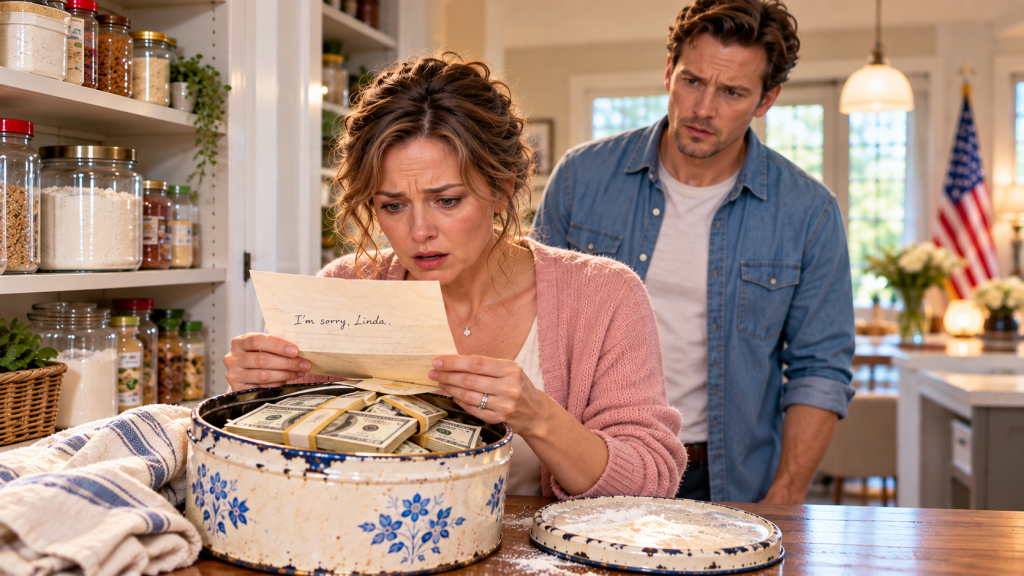
I cleaned out Mama’s pantry three days after the funeral and found $18,940 inside the flour tin she had spent forty years telling us never to touch.
Under the rubber-banded bills was an envelope with my name written across the front in Mama’s shaky blue handwriting.
Linda.
Not Russell.
Not “my children.”
Just me.
I opened it standing beside the kitchen counter, flour dust clinging to the sleeves of my black funeral blouse.
The first line said:
I’m sorry, Linda.
My brother Russell looked over my shoulder, saw the stacks of cash, and gave a nervous laugh.
“Probably grocery money she forgot.”
I stared at him.
There were nearly nineteen thousand dollars on the counter.
“Forgot?”
Russell shrugged.
“You know how Mama got near the end.”
But then I read the next sentence.
I should have told you what Wayne did with your settlement.
Russell stopped smiling.
And that was the moment I knew the money in the flour tin was not the biggest secret in Mama’s house.
Mama’s pantry was barely large enough for one person to stand inside, but she maintained it like a military supply room.
Green beans were arranged by expiration date.
Tomato soup went on the second shelf.
Sugar lived in a glass jar with a dented metal lid.
Coffee filters were stored in the same yellow Tupperware container she had owned since 1993.
She labeled boxes of baking soda even though the words BAKING SODA were printed across them in enormous letters.
Mama believed organization prevented disaster.
“If you know where everything belongs,” she used to say, “you know when something’s missing.”
The flour tin was the exception.
It sat on the highest pantry shelf, pushed against the wall behind two decorative cake plates Mama never used.
White enamel.
Little blue flowers.
Several chips around the rim.
A faded wooden handle on top.
It looked ordinary.
But touching it had always been forbidden.
When I was twelve, I decided to surprise Mama with biscuits.
She was outside hanging sheets on the clothesline.
I dragged one of the kitchen chairs into the pantry, climbed onto it, and reached toward the flour tin.
My fingers had barely touched the handle when Mama appeared behind me.
“Linda!”
I turned.
Her face was white.
Before I understood what was happening, she crossed the kitchen and slapped my hand away from the tin.
The smack shocked both of us.
Mama had never hit me before.
I burst into tears.
She immediately pulled me into her arms.
“Oh, honey. Oh, Lord. I’m sorry.”
That afternoon she made me cocoa and let me watch television even though it was a school night.
But the flour tin went back onto the top shelf.
I asked what was inside.
“Nothing you need.”
“Then why can’t I touch it?”
Mama stared at me for a long time.
“Because some things are better left alone.”
For decades, I assumed the tin contained old documents, emergency cash, maybe jewelry.
I stopped asking.
After Mama died at seventy-eight, Russell wanted her house cleared in two days.
He lived outside Memphis and acted like spending one additional night in our hometown might cause his organs to shut down.
He had a camper payment.
A bad back.
A lawn that supposedly needed mowing.
A supervisor who could not survive without him.
He complained about all four things repeatedly.
Wayne, our stepfather, had been dead six years.
Our biological father disappeared before I was old enough to remember him, so Mama’s belongings were ours to deal with.
Russell claimed the garage.
Naturally.
He wanted Wayne’s old tools, the riding mower, a fishing boat that had not moved since approximately the first Bush administration, and several boxes of rusty equipment he insisted were valuable.
I took the kitchen and pantry because nobody else wanted expired soup.
The house felt wrong without Mama in it.
Her slippers were still beside her bed.
Her reading glasses rested next to the kitchen phone.
A half-finished crossword puzzle lay on the coffee table.
On the refrigerator calendar, she had written DENTIST at ten o’clock on a Tuesday she never lived to see.
The kitchen smelled like cinnamon, lemon furniture oil, and the faint medicinal scent that had clung to everything during Mama’s final months.
I had a cardboard box marked DONATE beside my feet.
Inside were eleven cans of beets, three unopened bottles of pancake syrup, a container of toothpicks shaped like tiny umbrellas, and enough aluminum foil to survive the apocalypse.
I nearly skipped the flour tin entirely.
That childhood warning still lived somewhere inside me.
Don’t touch.
Some things are better left alone.
But Mama was gone.
There was nobody left to slap my hand.
I dragged over the same wooden chair I had used when I was twelve.
The seat creaked under my weight.
I reached up and grabbed the tin.
It was heavy.
Much heavier than flour should have been.
I lowered it carefully to the counter.
For several seconds, I simply stared at it.
Then I lifted the lid.
There was no flour inside.
Only money.
Twenties.
Fifties.
Hundreds.
Stacks folded neatly into bundles and secured with rubber bands that had grown dry and brittle.
Some bills were newer.
Others were old enough to have the smaller portrait designs I remembered from my twenties.
Mama had sprinkled a thin layer of flour around the top edges, apparently so anyone lifting the lid casually would think the tin was still being used for baking.
I counted the bundles twice.
$18,940.
Underneath them was the envelope.
Linda.
I was holding it when Russell walked in carrying Mama’s television remote wrapped in newspaper.
He saw the cash.
His entire expression changed.
It happened quickly.
Recognition.
Fear.
Calculation.
Then a careless little smile.
“Probably grocery money she forgot.”
I stared at him.
“You think Mama forgot almost nineteen thousand dollars?”
He shrugged.
“She got strange about cash after Wayne died.”
“How do you know how much is here?”
His eyes flicked toward me.
“What?”
“I didn’t tell you the total.”
Russell paused.
“I was guessing.”
“That was a very specific guess.”
“Oh, come on, Linda.”
I opened the envelope.
“Don’t.”
The word came too fast.
I looked up.
Russell immediately shook his head.
“I mean, maybe we should talk to the estate lawyer before opening personal papers.”
“It has my name on it.”
“Still.”
I tore the envelope.
The first sentence made my hands shake.
I’m sorry, Linda.
The next one almost knocked the air from my lungs.
I should have told you what Wayne did with your settlement.
I sat in Mama’s kitchen chair.
When I was seventeen, a delivery truck hit me outside the Piggly Wiggly.
I had gone there after school to buy milk and a loaf of bread.
I remembered stepping off the curb.
A horn.
Brakes screaming.
Then asphalt rushing toward my face.
My left leg broke in two places.
My hip was fractured.
I spent nine weeks in a cast and most of my senior year walking with crutches.
Physical therapy lasted another year.
For months, I woke at night convinced I could hear the truck again.
The delivery company eventually settled.
Wayne handled everything.
He met with the lawyer.
He talked to the insurance adjuster.
He collected the documents.
At seventeen, I was grateful.
Wayne had married Mama when I was nine.
For years, he was the closest thing I had to a father.
He taught Russell and me to fish.
He attended my school plays.
He helped me build a papier-mâché volcano when I was eleven.
He showed me how to change a tire.
He could be impatient, but he was dependable.
Or so I thought.
After the settlement was finalized, Wayne told me almost all of it had gone toward medical expenses and legal fees.
Mama sat beside him while he explained.
She cried quietly.
I remember Wayne squeezing her shoulder.
“We’re lucky,” he said. “Some families end up owing money after something like this.”
I believed him.
What reason would I have had not to?
Now, forty years later, Mama’s letter told another story.
She said she discovered the truth twelve years before Wayne died.
He had suffered a mild stroke.
While he was in the hospital, Mama searched the filing cabinet for insurance papers.
Behind a stack of old tax returns she found bank statements from an account she had never seen.
The account was connected to my settlement.
Money that should have been protected for me had been moved.
Transferred.
Invested.
Spent.
Mama confronted Wayne.
At first he denied it.
Then he blamed the lawyer.
Then he blamed the bank.
Then, finally, he admitted the truth.
He had taken the money.
Not to pay my medical bills.
Not because the family was desperate.
Because he believed he could “do something better with it.”
Mama wrote:
He said he intended to put it back before you ever knew.
I stopped reading.
My stomach churned.
Russell stood across from me.
“Linda.”
I looked at him.
“You knew something.”
“No.”
“You’re lying.”
“I didn’t know all of it.”
The words slipped out.
I stood so quickly the chair scraped backward.
“You just said you didn’t know.”
He rubbed the back of his neck.
“I knew Mama was upset about old money. That’s all.”
“What old money?”
“Linda, don’t do this.”
“Do what?”
“Dig up something everybody involved is dead over.”
“You are not dead.”
His jaw tightened.
“That’s not what I meant.”
I returned to the letter.
Mama said Wayne lost part of the settlement through bad investments.
But not all of it.
Some had been used to purchase property.
Some had gone into a business.
Some had been moved through accounts Mama did not initially understand.
After Wayne’s death, Mama began quietly recovering whatever she could.
The money in the flour tin was part of it.
Then I reached the final sheet.
It was folded separately.
Brown tape sealed the edge.
Across the front Mama had written:
Read this at First County Bank, not in the house.
I picked up the flour tin.
Russell stepped in front of me.
“You’re not going there.”
I stared at him.
“Move.”
“Mama wasn’t thinking clearly near the end.”
“This handwriting is years old.”
“You don’t know that.”
“The tape is practically fossilized.”
“Linda.”
“Move.”
He placed one hand on the flour tin.
“You can’t just take estate money.”
“It was sitting under a letter addressed to me explaining money stolen from me.”
“We need to talk to a lawyer.”
“Interesting that you suddenly care about procedure.”
His face hardened.
“Don’t be ridiculous.”
“Then take your hand off the tin.”
For several seconds, neither of us moved.
Finally, Russell let go.
I walked past him.
At 5:05 that evening, I entered First County Bank.
The lobby technically closed at five, but an older security guard named Frank recognized me.
He had attended Mama’s funeral.
“Linda Harris?”
“Yes.”
“You all right?”
“I need to speak to whoever handled my mother’s accounts.”
Frank looked at the flour tin under my arm.
Something flickered across his expression.
He immediately went to get someone.
The branch manager was a silver-haired man named Henry Keller.
He shook my hand, then looked at the tin.
His face went pale.
“Mrs. Harris finally left it to you.”
My throat tightened.
“You know about this?”
He closed his office door.
“Sit down.”
I did.
Mr. Keller opened a locked cabinet behind his desk and removed a thick file.
My mother’s full name was typed across the label.
Margaret Elaine Harris.
He set it between us.
“Your mother came here once a month for nearly six years.”
“Why?”
“She was preparing for this.”
He opened the file.
Inside were copies of checks.
Deposit records.
Property documents.
Handwritten notes.
And the original settlement statement from my accident.
Mr. Keller slid it toward me.
My eyes went directly to the figure near the top.
$74,600.
I stared.
“That can’t be right.”
“It is.”
“Wayne told me almost all of it went to bills.”
Mr. Keller pointed to the deductions.
Legal fees.
Hospital costs.
Therapy.
Less than thirteen thousand dollars.
After everything, more than fifty thousand dollars should have remained for me.
My fingertips went numb.
“Where did it go?”
“Your stepfather was appointed financial guardian because you were a minor.”
“Mama signed?”
“Yes.”
That hurt.
Mr. Keller must have seen it on my face.
“She believed the funds were being placed into an account for you.”
“But they weren’t.”
“No.”
I sat back.
For a moment I was seventeen again.
Leg in a cast.
Wayne beside the hospital bed.
Mama crying.
We’re lucky.
I whispered, “Why didn’t she tell me when she found out?”
Mr. Keller folded his hands.
“I think she was ashamed.”
“That doesn’t answer the question.”
“No.”
His voice softened.
“It doesn’t.”
He pushed the sealed page from Mama’s letter toward me.
“You should read that now.”
I broke the brittle tape.
Inside was an account number.
Russell’s full legal name.
And one sentence:
Your brother knows where the rest went, but he will never tell you unless you show him what is inside the blue safe-deposit box.
I looked at Mr. Keller.
“What blue box?”
He stood.
“Come with me.”
The bank vault was colder than the lobby.
Mr. Keller inserted one key.
I inserted another he gave me from Mama’s file.
Together we opened a narrow safe-deposit box.
Inside were three objects.
A small blue accounting ledger.
A cassette tape.
And a photograph.
I picked up the photograph.
Wayne stood beside Russell in front of a brick building.
Russell looked about twenty-four.
He held a shovel.
A banner behind them read:
HARRIS AUTO SERVICE — COMING SOON.
I recognized the building immediately.
Russell’s repair shop.
The business he had spent thirty years bragging he built from nothing.
I flipped the photograph over.
Mama had written:
Built with Linda’s money.
My knees nearly gave out.
I sat on the small bench.
“No.”
Mr. Keller remained silent.
I opened the blue ledger.
Wayne’s handwriting filled the pages.
Dates.
Dollar amounts.
Account numbers.
Notes.
$8,000 — equipment for Russell.
$12,500 — building deposit.
$3,400 — tools.
$6,200 — truck.
$9,750 — renovation.
$4,000 — operating cash.
The entries went on.
My settlement had not disappeared.
It had built my brother’s future.
I remembered Russell’s grand opening.
I had been twenty.
Mama made sandwiches.
Wayne gave a speech about hard work.
He stood beside Russell with one hand on his shoulder and said:
“This boy built something for himself.”
Everybody applauded.
Including me.
At that time, I was working evenings at a pharmacy because I could not afford college tuition.
I suddenly felt sick.
“The cassette,” Mr. Keller said gently.
We returned to his office.
He had an old player in a cabinet.
Mama’s voice crackled through the speaker.
“Linda, if you’re hearing this, then I’m gone.”
My eyes filled immediately.
I had not realized how badly I wanted to hear her again.
“I need you to know something before you decide what to do with Russell.”
I clenched my hands.
“He did not know at first.”
I closed my eyes.
“When Wayne gave Russell money for the garage, he told him it came from an investment. Russell was young. He believed him.”
Relief moved through me.
Briefly.
Then Mama continued.
“But he found out later.”
My eyes opened.
“In 2009, Russell discovered the settlement paperwork while helping Wayne move records. He came to me.”
Mama’s voice shook.
“I asked him to tell you with me.”
A pause.
“He refused.”
My stomach twisted.
“He said the shop was already supporting his family. He said Wayne had given him the money years before. He told me there was no sense destroying lives over something that could not be changed.”
I pressed my fingers against my mouth.
“I wish I could tell you I forced him to do the right thing. I didn’t.”
Mama breathed deeply on the tape.
“I was afraid.”
The word hung in Mr. Keller’s office.
“I had already spent years wondering how to tell you I failed to protect you. Then Russell begged me not to tear the family apart. I convinced myself silence was mercy.”
Mama’s voice cracked.
“It was cowardice.”
Tears slipped down my cheeks.
“The money in the flour tin is what I recovered after Wayne died. I sold an old parcel of land. I closed two investment accounts. I found cash he had hidden. I put aside every dollar I could.”
Then she said something that stayed with me forever.
“But the money is not the real inheritance.”
I looked toward the recorder.
“The truth is.”
The tape clicked softly.
“I spent too many years deciding what you should be allowed to know. That was wrong. The truth belonged to you from the beginning.”
Another pause.
“I’m sorry, Linda.”
The recording ended.
For several minutes, I said nothing.
Mr. Keller handed me tissues.
I barely noticed.
Eventually he gave me another envelope.
“Your mother instructed me to give you this after you heard the tape.”
Inside were notarized statements.
Documents transferring any recoverable claims connected to my settlement directly to me.
There was also a business card.
ELENA RUIZ, ATTORNEY AT LAW.
“Your mother consulted her several times,” Mr. Keller said.
“Was Mama planning to sue Russell?”
“No.”
“Why not?”
“She wanted you to choose.”
Before leaving the bank, I deposited the $18,940 into an account in my name.
I did not feel richer.
I felt hollow.
When I drove back to Mama’s house, Russell was sitting on the porch.
His suitcase stood beside him.
He looked at the flour tin in my passenger seat.
“You opened the box.”
“Yes.”
His shoulders dropped.
“Mama promised me she wouldn’t.”
I stared at him.
“She promised me plenty too.”
He looked away.
For the first time in my life, my older brother seemed frightened of me.
“Tell me the truth,” I said.
“Linda—”
“All of it.”
Russell sat down.
I remained standing.
He rubbed his hands together.
“When Wayne gave me the money, I thought it was his.”
“When?”
“1988.”
“You were twenty-three.”
“Yes.”
“And when did you learn it was mine?”
He hesitated.
“2009.”
“Twenty-one years later.”
“Yes.”
“What did you do?”
His eyes dropped.
“Nothing.”
The answer was so simple I almost laughed.
“Nothing.”
“I confronted Wayne.”
“That is not nothing for me. That is something for him.”
“I asked him what happened.”
“And?”
“He said your settlement money was family money.”
I felt heat rise in my face.
“Family money.”
“That’s what he said.”
“And you accepted that?”
“No.”
“Then why didn’t you tell me?”
“My entire business was tied to it.”
“So?”
“I had employees. A mortgage. Two kids headed toward college.”
I stared at him.
“And I didn’t have a life?”
“That’s not what I meant.”
“When I was twenty-six, I lived in an apartment where the ceiling leaked into a bucket.”
“I didn’t know.”
“When Emily needed braces, I put them on a credit card.”
“I didn’t know that either.”
“When my marriage ended, I worked six days a week because I was afraid I’d lose my house.”
He said nothing.
“You knew money that should have belonged to me built your business.”
His eyes filled.
“Yes.”
“You knew.”
“Yes.”
“Every Christmas.”
“Yes.”
“Every birthday.”
“Yes.”
“Every time you bragged about building that shop from scratch.”
His voice dropped.
“Yes.”
I stepped backward.
That hurt more than Wayne’s theft.
Wayne was dead.
I could rage at him safely.
Russell was alive.
He was my brother.
He had watched me struggle.
“I told Mama I’d repay some,” he said.
“How much?”
“Five thousand.”
“Once?”
“Yes.”
“In twelve years?”
He winced.
“I had expenses.”
The sentence came out before he could stop it.
I laughed.
A harsh sound.
“You had expenses.”
“I know how that sounds.”
“No. I don’t think you do.”
He stood.
“I was scared.”
“So was I. I was scared for years, Russell. I just didn’t know you were part of the reason.”
He wiped at his eyes.
“What are you going to do?”
“I’m meeting Elena Ruiz tomorrow.”
His face tightened.
“You’re suing me.”
“I said I’m meeting a lawyer.”
“If you come after the shop, you could destroy everything.”
There it was.
His first instinct.
Protect the shop.
Protect Russell.
I picked up Mama’s house key from the table.
“You need to leave.”
“Linda.”
“Tonight.”
“This is my mother’s house too.”
“And tonight I cannot look at you inside it.”
He stared at me.
Then he picked up his suitcase.
At the bottom of the steps, he stopped.
“I am sorry.”
I believed he meant it.
That did not mean I forgave him.
The next morning, I met Elena Ruiz.
She was seventy if she was a day, with white hair twisted into a knot and glasses hanging from a chain around her neck.
She spread Mama’s records across a conference table.
For nearly two hours, she said very little.
Finally, she leaned back.
“Your mother documented this extremely well.”
“Can I recover the money?”
“Some.”
“From Russell?”
“Possibly.”
She explained the legal complications.
Wayne’s estate had been closed for years.
Some records were old.
Some assets no longer existed.
But there was evidence that money from my settlement directly financed Russell’s building and equipment.
Better yet, Mama had gotten Wayne to sign a written confession after his stroke.
Elena handed it to me.
Wayne’s handwriting filled two pages.
He admitted moving the settlement.
He admitted using some to finance Russell’s business.
Then I read one sentence that made my vision blur.
Linda is resilient. She will be fine without it.
I read it again.
Resilient.
Such a lovely word.
Such a convenient word.
People call you resilient when they want to admire how well you survived something they never should have done to you.
I placed the confession down.
“What are my choices?”
Elena folded her hands.
“Litigation. Private settlement. Mediation. Or you can take what your mother recovered and walk away.”
“What would you do?”
She shook her head.
“Not my decision.”
“I don’t want to destroy Russell.”
“Then don’t.”
“But I also don’t want him getting away with it.”
“Those are not the only two possibilities.”
She leaned forward.
“You can hold someone accountable without making destruction the goal.”
That sentence changed everything.
Three days later, Russell came back.
He carried a cardboard banker’s box.
“I brought everything.”
Inside were thirty years of business records.
Old deeds.
Tax returns.
Property assessments.
Bank statements.
Loan paperwork.
“I want to fix it,” he said.
I looked at him.
“Why now?”
“Because I finally understand what Mama meant.”
“What did Mama mean?”
“She kept saying secrecy was destroying all of us.”
His eyes moved around the kitchen.
“I thought telling you would destroy the family.”
He gave a broken little laugh.
“Turns out hiding it did.”
We sat at Mama’s table.
Russell admitted that after discovering the truth, he confronted Wayne first.
Wayne told him he was being ridiculous.
He said the money had been invested in “the family.”
He said I had married and moved away.
He said I did not need it.
“He told me you were always better at surviving hard things.”
Russell’s voice broke.
“I used that as an excuse.”
I thought about Wayne’s confession.
Linda is resilient.
Apparently my ability to survive had become everybody’s permission to hurt me.
Russell continued.
“I kept telling myself I’d repay you eventually.”
“Why didn’t you?”
“Because eventually is easy when you never pick a date.”
That was probably the most truthful thing he had said.
He slid an appraisal toward me.
The original shop property was worth far more than he had paid.
“I’ll sell the building.”
I stared at him.
“What?”
“I can move the business.”
“You’d sell it?”
“Yes.”
“What happens to your employees?”
“I rent another location. They come with me.”
“You might lose customers.”
“I might.”
“You might lose money.”
“I probably will.”
I studied his face.
“You’re willing to do that?”
“I should have been willing years ago.”
I did not answer.
“I’m not asking you to forgive me,” Russell said.
“Good.”
“I just don’t want my last decision about this to be the same cowardly one.”
Over the next several months, Elena handled the negotiations.
Russell sold the building.
The process was messy.
Taxes.
Business obligations.
Closing fees.
Equipment financing.
But after everything was settled, I received $63,000 from the sale.
Combined with Mama’s recovered money and two small accounts she had left for me, the total exceeded the amount Wayne originally stole.
Elena pointed out that if properly invested for decades, the settlement might have become much more.
But eventually, I stopped calculating.
There was no number that could return the years.
I paid off the final piece of my mortgage.
I cleared the credit card balance I had carried too long.
I placed money into savings for Emily.
Then I did something completely frivolous.
I spent $2,400 taking Emily and my granddaughter Sophie to the ocean.
Mama had promised me a beach trip after my accident.
We never went.
The first morning there, I stood barefoot in the water while Sophie chased gulls.
Emily came beside me.
“You okay?”
“Yes.”
I meant it.
For the first time since opening the flour tin, I felt something besides anger.
Not forgiveness.
Not yet.
Freedom.
When we returned, I resumed clearing Mama’s house.
While removing clothes from her dresser, I found another envelope taped beneath the bottom drawer.
My name and Russell’s were written together.
I called him.
“Come over.”
He arrived thirty minutes later.
We sat at Mama’s kitchen table.
I opened the envelope.
My children,
If you are reading this together, perhaps I received more mercy than I deserve.
If you are reading it separately, I understand.
I looked at Russell.
He swallowed.
I continued.
I spent most of my life believing peace meant preventing people from becoming angry.
I was wrong.
Sometimes peace requires telling the truth even if the truth breaks the room apart first.
Wayne loved this family.
That is part of what made his wrongdoing difficult for me to face.
He was not cruel every day.
He was generous sometimes.
He worked hard.
He cared for me when I was sick.
He loved you children in his way.
But loving someone does not give you the right to steal from them.
I stopped.
Russell looked down.
Mama continued.
Wayne convinced himself the family mattered more than Linda’s individual rights.
He chose who should sacrifice without asking the person who would pay the price.
I helped him do that by remaining silent after I learned the truth.
Then came the words that finally shattered me.
Linda, I fear you may believe my silence meant I loved Russell more.
I did not.
It meant I was weaker than you deserved your mother to be.
I covered my face.
All my life, some part of me had wondered.
Russell was the son.
The successful one.
The child who understood Wayne.
I was emotional.
Stubborn.
Always asking questions.
Even before learning about the settlement, I sometimes felt Mama protected Russell in ways she never protected me.
Now I understood she had feared exactly that.
Russell took the letter from me and continued reading aloud.
Russell, when you discovered the truth, you made my mistake in another form.
You protected what belonged to you by allowing your sister to carry the cost.
I know you were afraid.
Fear explains wrongdoing.
It does not erase it.
Russell’s voice cracked.
He stopped.
I finished.
I hope the two of you do not spend the rest of your lives punishing each other for choices Wayne and I made.
But I also hope forgiveness, if it comes, will be honest.
Forced forgiveness is only another kind of lie.
Love,
Mama.
For several minutes, neither of us spoke.
Then Russell started crying.
Not quietly.
Not politely.
He covered his face with both hands and cried like a child.
“She knew,” he whispered.
“Yes.”
“I thought she hated me at the end.”
“She didn’t.”
“She barely talked to me.”
“She was ashamed.”
“So was I.”
I reached across the table.
I did not hug him.
Not yet.
But I rested my hand beside his.
It was the first step.
A few weeks later, we held an estate sale.
Russell carried the flour tin toward a trash pile.
“Absolutely not,” I said.
He looked at me.
“You’re keeping this ugly thing?”
“Yes.”
“Why?”
“I don’t know yet.”
So I took it home.
For several months, it sat empty above my refrigerator.
Every time I saw it, I thought about secrets.
How ordinary they can look.
How heavy they become.
How families can organize entire lives around something nobody is supposed to touch.
Then Emily came over one Saturday.
She noticed the tin immediately.
“Grandma’s forbidden flour can?”
“Tin.”
“Whatever.”
She opened it.
I flinched.
Emily laughed.
“You’re still scared of touching this thing?”
Apparently I was.
She looked inside.
“Empty.”
“Not for long.”
That afternoon, I told my daughter the entire story.
I had avoided telling her because I did not want her memories of Mama ruined.
Emily listened without interrupting.
When I finished, she sat quietly.
Finally she said, “Why did you think you needed to protect Grandma from the truth?”
I blinked.
“I didn’t want you to think badly of her.”
“Mom.”
She gave me the same look I used to give Mama when she was being stubborn.
“You don’t have to protect dead people from facts.”
I laughed.
Then I cried.
“You sound exactly like me.”
“That should concern both of us.”
Emily picked up the flour tin.
“Put the letters in here.”
So I did.
Mama’s first letter.
The bank documents.
The photograph of Russell and Wayne.
A copy of Wayne’s confession.
Mama’s final letter.
Then I wrote one myself.
It began:
If you are reading this, our family finally learned that secrets do not disappear simply because good people are afraid of telling the truth.
I wrote about everything.
Wayne.
Mama.
Russell.
My accident.
The money.
The shop.
The bank.
The years of silence.
And what happened afterward.
I wanted my grandchildren to understand something it had taken me sixty years to learn.
People are not simple.
Wayne could teach me to change a tire and still steal from me.
Mama could love me deeply and still fail to protect me.
Russell could betray me and later choose accountability.
And I could forgive without pretending none of it happened.
At the end I wrote:
Never confuse keeping quiet with keeping peace.
Then I placed the letter in the flour tin.
Russell and I slowly became siblings again.
Different siblings.
More honest ones.
For the first time in our lives, we stopped using Mama as the bridge between us.
Sometimes we fought.
Real fights.
He accused me of mentioning the settlement whenever he annoyed me.
I accused him of becoming defensive whenever money came up.
Once, during Thanksgiving, I snapped, “At least I didn’t finance my turkey with stolen funds.”
The whole table went silent.
Russell stared at me.
I immediately regretted it.
Later, I apologized.
“I deserved that one,” he said.
“No.”
He looked surprised.
“You deserved accountability. Not endless humiliation.”
That mattered.
Forgiveness, I discovered, was not one dramatic decision.
It was dozens of small decisions.
Whether to answer the phone.
Whether to invite him for Christmas.
Whether to let him make a joke.
Whether to stop using the past as a weapon once he had honestly faced it.
A year after the settlement, Russell invited me to Memphis.
His new shop was smaller.
He rented the building instead of owning it.
The waiting room had mismatched chairs.
The sign outside looked cheaper.
But Russell seemed lighter.
Above his office door hung a photograph of Mama.
The frame was slightly crooked.
“She would hate that,” I said.
“I straighten it every morning.”
“It’s still crooked.”
“She’s haunting me.”
We laughed.
At lunch, he pushed an envelope across the diner table.
Inside was a check for five thousand dollars.
“What is this?”
“The money I once gave Mama.”
“That was part of what she recovered.”
“No.”
He shook his head.
“She gave it back.”
“Why?”
“She said repayment didn’t count if I was only giving her enough to keep quiet.”
I almost smiled.
“That sounds like her.”
“I spent it.”
His shame returned.
“So I’m paying it now.”
I pushed the check back.
“No.”
His face fell.
“Linda.”
“I don’t want it.”
“Why?”
“Because I want us to do something useful with it.”
“What?”
“Help another kid.”
He frowned.
“Explain.”
I thought about seventeen-year-old me.
A cast.
A settlement.
Adults making decisions.
No idea what papers were being signed.
“Families don’t always understand settlements. Guardianship accounts. Legal rights. We could help kids and parents get independent advice.”
Russell sat back.
“You want to start some kind of fund?”
“Maybe.”
He smiled slowly.
“Mama would say we were getting too fancy.”
“Absolutely.”
We contacted Elena.
She connected us with a nonprofit serving injured children and low-income families.
Russell contributed the five thousand.
I matched it.
We created a small financial education fund.
We named it for Mama.
The Margaret Harris Family Financial Education Fund.
Russell hated the name.
“She’d rise out of the cemetery just to complain.”
“She’d ask why her middle name isn’t on it.”
“She’d ask whether the bank charged us a fee.”
We laughed.
The first year, the fund helped four families.
The second year, nine.
A few needed lawyers.
Others needed someone to explain a trust account.
One mother simply needed an independent professional to tell her that a relative pressuring her to “borrow” her child’s settlement money was not normal.
After that meeting, I sat in my car and cried.
Every family we helped felt like reaching backward through time.
Not changing what happened.
Just refusing to let it happen again without resistance.
The flour tin stayed on my refrigerator.
One Thanksgiving, Sophie climbed onto a stool and reached for it.
She was nine.
My heart jumped.
For one second, I saw my twelve-year-old hand.
Mama rushing toward me.
The slap.
Sophie froze.
“Grandma?”
“Yes?”
“Am I allowed to touch this?”
I smiled.
“Yes.”
She carefully carried it to the table.
“What’s inside?”
“Family history.”
Her eyes widened.
“Treasure?”
“Kind of.”
“Money?”
“Not anymore.”
She opened the lid.
Inside were letters and photographs.
She picked up Mama’s picture.
“Is this Great-Grandma Margaret?”
“Yes.”
“The pie lady?”
I laughed.
“The pie lady.”
Sophie looked at the documents.
“I don’t understand these.”
“You will someday.”
“Is it a secret?”
That question made me pause.
“No.”
“Then why keep it in a box?”
“So nobody forgets.”
She nodded as though that made perfect sense.
Children often understand things adults spend decades complicating.
Years passed.
The fund grew.
Russell’s shop recovered.
He eventually bought a smaller building using money he saved himself.
At the opening, he invited me to cut the ribbon.
I declined.
“You earned this one,” I told him.
He understood exactly what I meant.
Above the entrance, he placed a little brass plaque.
BUILT HONESTLY.
I thought it was corny.
I loved it anyway.
When Russell retired at sixty-eight, his oldest mechanic bought the business.
Russell used part of the sale to create trade-school scholarships.
He never asked me for recognition.
He never told people the whole story.
He simply became very particular about money.
Every agreement had to be written.
Every partnership documented.
Every employee contribution independently verified.
His children teased him for it.
Once his son asked why.
Russell said:
“Because money and family are a dangerous combination when nobody wants to ask uncomfortable questions.”
That sounded like something Mama might eventually have learned to say.
When we were both in our seventies, we returned to Mama’s old house.
A young family lived there.
The kitchen was yellow now.
Mama would have hated it.
The new owner, Tara, recognized us.
She invited us inside.
“I hope you don’t mind the changes,” she said.
Russell whispered, “She would.”
I elbowed him.
Tara opened the pantry.
The shelves were the same.
I stood in the doorway.
For a moment, I smelled cinnamon.
Lemon oil.
Coffee.
Memory can resurrect a room faster than any photograph.
Russell pointed toward the top shelf.
“That’s where it lived.”
Tara frowned.
“What?”
“The flour tin,” I said.
She smiled politely.
I looked at Russell.
We both started laughing.
Tara probably thought grief had made us strange.
Maybe it had.
Before we left, I stood alone in the kitchen.
The house no longer belonged to us.
Mama was gone.
Wayne was gone.
The money had been found.
The debt had been repaid.
The truth had been spoken.
For years, I believed discovering the truth would change my childhood.
It did not.
Wayne still taught me to fish.
He still attended my school plays.
He still sat beside my hospital bed.
And he still stole my money.
Mama still made cocoa when I cried.
She still worked two jobs when we were small.
She still held my hand when my marriage ended.
And she still stayed silent after discovering what Wayne had done.
Russell still pulled me home on his bicycle when I cut my knee at eight.
He still beat up a boy who called me ugly in seventh grade.
He still knew about my money and chose his own security.
Humans are inconvenient that way.
We want villains who are villains every hour.
Victims who are innocent in every choice.
Parents who either love or fail.
Brothers who are either loyal or selfish.
But real families are messier.
Recognizing complexity did not require me to excuse anybody.
What Wayne did was wrong.
Mama’s silence was wrong.
Russell’s silence was wrong.
I did not need to soften those truths in order to remember their humanity.
Years later, Russell became ill.
Cancer.
By then he was seventy-four.
The treatments stopped working after eighteen months.
One warm afternoon, he sat with me on my back porch.
Birds hopped around the feeder.
Russell had lost so much weight his wedding ring no longer fit.
He looked toward my kitchen window.
“You still have that ugly flour tin?”
“Of course.”
“You should burn it.”
“Never.”
“Emily getting it?”
“Yes.”
“Poor woman.”
We smiled.
Then he became serious.
“Linda.”
“What?”
“Do you forgive me?”
I had known the question would come someday.
I had imagined giving some wise answer.
When the moment arrived, I simply said:
“Yes.”
He nodded.
Then I added, “But I didn’t for a long time.”
“I know.”
“You weren’t entitled to forgiveness.”
“I know.”
“And forgiveness doesn’t mean what you did became acceptable.”
His eyes filled.
“I wouldn’t want it to.”
I reached across and took his hand.
“We lost years.”
“Yeah.”
“But not all of them.”
He squeezed my fingers.
“No.”
Russell died that winter.
At his funeral, his oldest son spoke about the repair shop.
His daughter spoke about the scholarships.
One mechanic told a story about Russell quietly paying for an employee’s wife to travel for cancer treatment.
I sat listening.
People described the brother I knew.
Generous.
Stubborn.
Funny.
Proud.
Flawed.
Loved.
After the service, Russell’s daughter came to me.
“Dad wanted you to have something.”
She gave me an envelope.
Inside was the photograph from Mama’s safe-deposit box.
Russell and Wayne standing in front of the original shop.
I turned it over.
Mama’s words were still there.
Built with Linda’s money.
Below them, Russell had added a sentence.
The second shop was built with the truth.
I cried in the church parking lot.
Then I placed the photograph inside the flour tin.
I am seventy-six now.
The flour tin no longer sits in my kitchen.
It belongs to Emily.
She keeps it on a low shelf.
Not the top one.
Anyone can open it.
Inside are Mama’s letters.
Wayne’s confession.
The photograph.
Copies of the bank records.
A newspaper clipping about the family education fund.
My letter.
And one twenty-dollar bill from Mama’s original $18,940.
Emily once asked why I kept that bill.
“Spend it on something fun,” she said.
I shook my head.
“No.”
“Why?”
“Because some money should stop being money.”
She understood.
Now, every Thanksgiving, somebody eventually opens the tin.
Someone tells the story.
Not exactly the same way every time.
Stories change slightly with each teller.
But the important parts remain.
A seventeen-year-old girl was hurt.
Money belonging to her was taken.
A mother learned the truth and waited too long to speak.
A brother learned later and chose fear over honesty.
Decades passed.
Then a flour tin opened.
And once it opened, everything else did too.
Last Thanksgiving, Sophie was twenty-three.
She sat beside me after dinner with Mama’s letter in her hands.
“Grandma?”
“Yes?”
“If Great-Grandma had told you the truth immediately, would you have forgiven her faster?”
I thought about it.
“I don’t know.”
“Would everything have been better?”
“Some things would.”
“Why didn’t she tell you?”
“Fear.”
Sophie looked at Mama’s handwriting.
“Why do grown-ups always think waiting will make scary things easier?”
I smiled.
“Because tomorrow feels safer than today.”
“Is it?”
“Usually not.”
I reached over and touched the edge of the flour tin.
“Tomorrow usually gives fear one extra day to practice.”
Sophie considered that.
Then she carefully folded Mama’s letter and put it back.
For most of my life, I thought the flour tin contained the secret that destroyed my family.
I was wrong.
The secret had already been destroying us.
The flour tin contained the thing that finally gave us a chance to stop.
Truth.
Not comfortable truth.
Not convenient truth.
The kind that changes the shape of every memory around it.
The truth did not return my lost years.
It did not make Wayne’s theft disappear.
It did not erase Mama’s cowardice.
It did not automatically restore my relationship with Russell.
But truth returned something money never could.
Choice.
For the first time, I could choose what happened next.
I could sue.
I could negotiate.
I could walk away.
I could stay angry.
I could demand repayment.
I could forgive someday.
I could refuse to forgive.
The decision finally belonged to me.
That was the thing Wayne stole long before he stole the money.
Choice.
He decided I did not need my settlement.
Mama decided I did not need to know.
Russell decided I was better off remaining ignorant.
All three of them, in different ways, treated my life as something they were entitled to manage.
The flour tin ended that.
Mama understood it too late.
But she understood.
That was why the cash alone was never the real inheritance.
The inheritance was the truth.
The right to know.
The right to choose.
The right to be angry.
The right to heal in my own time.
And maybe that is why I never threw the tin away.
Not because I wanted our family to remain trapped in what happened.
Because I wanted the generations after us to remember what silence costs.
Today the blue paint around its rim is almost completely chipped away.
The lid sticks.
The white enamel has yellowed.
The little blue flowers are fading.
It probably isn’t worth five dollars.
But if Sophie has children someday, I hope she keeps it.
I hope one of them asks why an ugly old flour tin sits on a kitchen shelf.
And I hope Sophie tells them:
Because a family once hid something terrible for too long.
Then someone finally opened the lid.
And the truth came out.
Not all at once.
Not neatly.
Not without pain.
But it came.
And once it did, nobody ever had to pretend again.
Sometimes I still think about that afternoon when I was twelve.
Standing on the wooden chair.
Reaching toward the tin.
Mama rushing into the pantry.
Her hand striking mine.
Her terrified face.
For decades, I remembered only the slap.
Now I understand what I had almost touched.
By then, Wayne had already stolen my settlement.
Some of the money may already have been hidden there.
Mama might have known something was wrong.
Maybe she didn’t yet know everything.
Maybe she was afraid I would open the tin and ask questions she could not answer.
Maybe that was the first moment the secret frightened her.
I will never know.
There are questions death takes with it.
I have learned to live with that.
Not every mystery needs solving.
Not every hurt gets a perfect explanation.
Sometimes the best we can do is stop adding new silence to old silence.
So whenever my family asks what Mama was like, I tell the whole truth.
She was funny.
She was stubborn.
She could stretch one chicken into three dinners.
She sang hymns off-key while washing dishes.
She loved lemon drops.
She hated driving at night.
She once chased a raccoon off the porch with a broom.
She loved her children fiercely.
And when it mattered most, she was afraid.
Both things are true.
When they ask about Wayne, I tell the truth too.
He could be kind.
He taught me useful things.
He loved our family in ways that were real.
He also stole from me.
Love did not erase theft.
Theft did not erase every decent thing he ever did.
Again, both truths can exist.
And when they ask about Russell, I smile.
Because that one is easiest now.
My brother failed me.
Then he spent the rest of his life trying to become the kind of man who would not fail someone that way again.
I think that matters.
Not because repentance erases damage.
Because change is the only apology time can prove.
Sometimes, late at night, I imagine Mama sitting at her kitchen table stuffing bills into the flour tin.
Twenty dollars.
Fifty dollars.
A hundred.
Month after month.
Maybe her hands shook.
Maybe she cried.
Maybe she counted every bundle and calculated how far she still was from fixing what could never completely be fixed.
I imagine her sliding my letter beneath the cash.
Closing the lid.
Pushing the tin onto the top shelf.
Waiting.
Probably praying she would find the courage to tell me before death forced the truth out for her.
She never did.
That makes me sad.
But I no longer need to punish her.
Mama was right about one thing.
Some things are better left alone.
Not truth.
Never truth.
But anger, once it has finally finished teaching you what it came to teach.
That, eventually, can be set down.
The money is mostly gone now.
Some paid debt.
Some went into savings.
Some helped Emily.
Some funded vacations.
Some helped strangers.
Some became scholarships.
Some became advice for children who otherwise might have grown up wondering where their own money went.
I like that.
Money Wayne stole from one injured seventeen-year-old eventually helped protect dozens of others.
That feels like a kind of justice no courtroom could have designed.
And the flour tin?
It remains.
Empty of cash.
Full of truth.
Exactly where everyone can reach it.
💬THE END! THANK YOU FOR READING!